
If you are machining nylon, you may have faced problems like:
- Melting edges
- Poor surface finish
- Vibration during cutting
Many buyers are unsure whether to use a CNC router or a CNC gantry milling machine.
Based on our real machining experience, the wrong machine choice can significantly affect your production quality and efficiency.
In this article, we will help you choose the right solution.olution.
CNC gantry mill vs CNC router for nylon machining is one of the most common debates I hear from shop owners and machinists every single day.
I’ve spent 14 years running both light-duty CNC gantry mills and standard CNC routers, cutting nylon, fiberglass, and composite materials day in and day out.
Too many buyers think a gantry mill is just a “bigger router” or a router is a cheap substitute for a gantry mill—and that mistake costs them thousands in scrapped parts, delayed orders, and wasted tooling.
Today, I’m breaking down the real, hands-on differences between these two machines, focused entirely on machining nylon and soft composites. No fancy engineering jargon, just shop-proven facts, performance data, and a real case study to help you pick the right machine for your work.
CNC Gantry Mill vs CNC Router for Nylon Machining: Core Structural Rigidity Comparison
Rigidity is the number one difference between a CNC gantry mill and a CNC router—especially when cutting nylon, which can flex, vibrate, and warp if the machine isn’t stable.
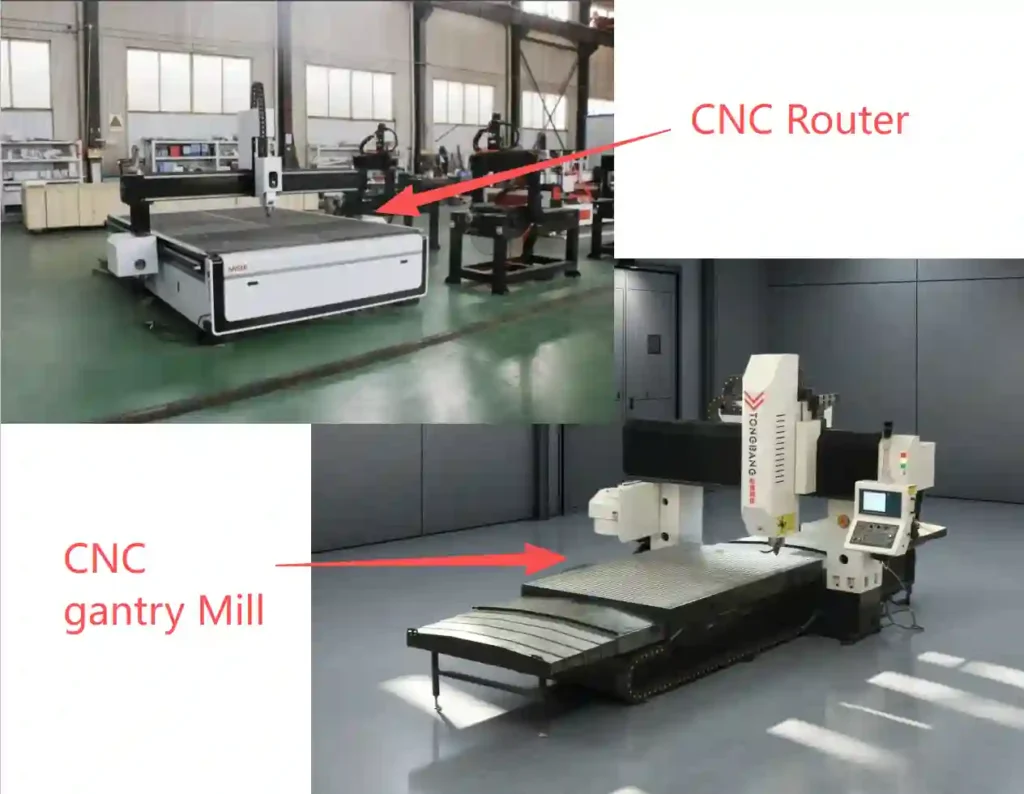
Let’s cut straight to the shop reality, not manufacturer spec sheets.
Standard CNC Router (Woodworking/Advertising Grade)
Nearly all entry-level CNC routers use lightweight aluminium profile frames or thin, welded steel, with an open, semi-enclosed design.
Their columns and crossbeams have small cross-sections, built for light, fast moves—not consistent cutting pressure.
Most routers use cheap round linear rails or low-grade square guides, paired with standard ball screws or even trapezoidal lead screws.
When cutting thick nylon or fibreglass-reinforced nylon, this weak structure causes constant micro-vibration.
Vibration leads to wavy nylon surfaces, dimensional drift, chipped edges, and faster tool wear. You can’t run fast feeds or deep cuts without ruining the part.
Light-Duty CNC Gantry Milling Machine
A proper light-duty gantry mill uses cast iron or stress-relieved welded steel for a fully enclosed, rigid portal frame.
It comes standard with heavy-duty square linear guides and precision-ground ball screws, with wider contact surfaces and preloaded components for zero flex.
This rigid structure kills vibration entirely, even when running aggressive cuts on thick nylon sheets.
For nylon machining, that means smooth surfaces, tight tolerances, and no material deflection—even during long production runs.
If you want to learn more about how linear guides and ball screws impact cutting stability, check our full guide: Guideways and Screws for CNC gantry mill.
CNC Gantry Mill vs CNC Router for Nylon Machining: Rigidity & Precision
Precision matters more for nylon than most people realize—especially if you’re making assembly parts, jigs, or prototype components.
The control and drive system separate a “cutting machine” from a “precision machining tool.”
CNC Router System Limitations
Most standard routers use PC-based open systems like Mach3 or basic budget controllers, with weak anti-interference performance.
They often run stepper motors, which can lose steps during long cuts, leading to inconsistent part sizes.
Typical precision for routers is around ±0.1mm or worse—fine for wood signs or basic plastic blanks, but useless for precision nylon parts.
Long runs make the precision drift even worse, and you’ll end up with parts that don’t fit together.
CNC Gantry Mill Precision Advantages
Light-duty gantry mills use industrial closed-loop CNC systems: FANUC, SIEMENS, or professional domestic controllers with true look-ahead and error compensation.
Full servo motors are standard, with zero step loss, fast response, and consistent torque.
Precision hits ±0.01mm or better—critical for nylon parts that need tight tolerances and consistent batch production.
Nylon surfaces come out smooth with minimal tool marks, no sanding needed, and every part in a batch matches perfectly.
For global industrial machining standards related to plastic and composite cutting, you can refer to the official ISO website.
Nylon Machining Performance: Full Side-by-Side Comparison Table
This table is based on real shop tests cutting 30mm thick nylon (standard and fiberglass-reinforced), no inflated specs—just what we measured on the floor.
| Factor | CNC Router | CNC Gantry Milling Machine |
|---|---|---|
| Structure | Lightweight | Heavy-duty rigid structure |
| Cutting Stability | Low | High |
| Surface Finish | Average | Excellent |
| Suitable Thickness | Thin sheets | Thick nylon blocks |
| Efficiency | Medium | High |
| Long-term Accuracy | Poor | Stable |
CNC Gantry Mill vs CNC Router for Nylon Machining: Real Shop Case
Last year, a local fixture shop came to me frustrated with their CNC router results.
They were making custom nylon jigs for assembly lines, requiring ±0.03mm tolerances, and their router couldn’t hit the mark.
They scrapped nearly 35% of their nylon parts due to wavy surfaces, size drift, and misaligned holes. They were losing clients and falling behind on deadlines.
We switched them to a light-duty CNC gantry mill, keeping the same nylon material and tooling.
The results were night and day:
- Scrapped nylon parts dropped from 35% to less than 2%
- Cutting speed increased by 2.5x, cutting lead times in half
- Nylon jig surfaces were smooth; no sanding or rework needed
- Tolerances held steady at ±0.01mm for every batch
They told me the gantry mill paid for itself in 6 months just by eliminating scrap and speeding up production.
Final Recommendation:
If you are machining thin nylon sheets (below 20mm), a CNC router can be a cost-effective solution.
However, for thicker nylon materials or higher precision requirements, a CNC gantry milling machine is strongly recommended.
From our experience, most industrial nylon processing applications benefit more from gantry milling machines.
Best Uses: When to Choose a CNC Gantry Mill vs a Router for Nylon machining
- Rigidity and Stability
In nylon machining, vibration is a common problem.
From our 10+ years of experience, CNC routers often struggle when cutting thicker nylon sheets. This leads to unstable cutting and poor surface quality.
Gantry milling machines, with their heavy structure, provide much better stability.
2.Stick with a CNC Router If:
You only cut thin nylon sheets for signs, simple blanks, or one-off low-precision projects.
You run the machine occasionally, not for daily full-shift production.
You have a tiny budget and don’t care about tolerances or long-term reliability.
3.Choose a CNC Gantry Mill according to the CNC Gantry Mill Selection If:
You make precision nylon jigs, fixtures, composite parts, or batch production components.
You need tight, consistent tolerances and smooth surface finishes.
You run 8+ hour days and need a machine that holds up long-term.
You work with fiberglass-reinforced nylon or thick nylon stock (over 20mm).
4.Final Shop Veteran Takeaway
A CNC router is a cheap, light-duty tool for basic nylon cutting—but it’s not a real machining solution.
CNC gantry mill vs CNC router for nylon machining isn’t about size or price—it’s about getting parts right the first time, reducing waste, and keeping your shop profitable.
Final Recommendation:
If your nylon thickness is above 20mm, or you require precision better than ±0.05mm, a CNC router will not meet your production needs.
In real production environments, we have seen many customers lose time and money using routers for industrial nylon parts.
A CNC gantry milling machine is not just an upgrade—it is a necessary investment for stable production.
If you are serious about nylon machining, choosing the right machine from the beginning will save you significant costs.
Many buyers choose CNC routers to save initial cost—but end up paying more in scrap, rework, and lost orders.
So which one should you choose?
Choose a CNC router if:
- You only process thin plastic sheets
- Your budget is limited
Choose a CNC gantry milling machine if:
- You process nylon blocks or thick materials
- You need better precision and surface finish
- You want long-term stable production
For most industrial nylon machining applications, a gantry milling machine is the better choice.
In one of our customer cases, a client machining nylon sheets (30–80mm thickness) switched from a CNC router to our gantry milling machine.
Results:
- Surface quality improved significantly
- Machining efficiency increased by 30%
- Tool wear reduced