
Hey everyone, Mocheng here.
Today, let’s talk about the Daily Maintenance & Operation Standards for CNC gantry mills. Been a bit free lately—spent a few days chilling in the office with the AC, sketched up some drawings, then rolled back into the workshop today.
Fingers itching, fired up a machine to run a job, and thought I’d take this chance to chat with you all again about the columns and crossbeams of our gantry mills.
In the last couple of posts, we covered how to select the right model and went over some common issues. Today, let’s get down to the nitty-gritty: how to properly maintain these two “main beams”—the columns and crossbeam of CNC gantry mills—so they keep working reliably for years without letting us down.
We deal with machine tools daily, and honestly, they’re just like people: give them a little extra care, and they won’t fail you when it counts. The column and crossbeam form the backbone of the machine tool. The strength and alignment of this structure directly determine whether our finished products are premium quality or scrap.
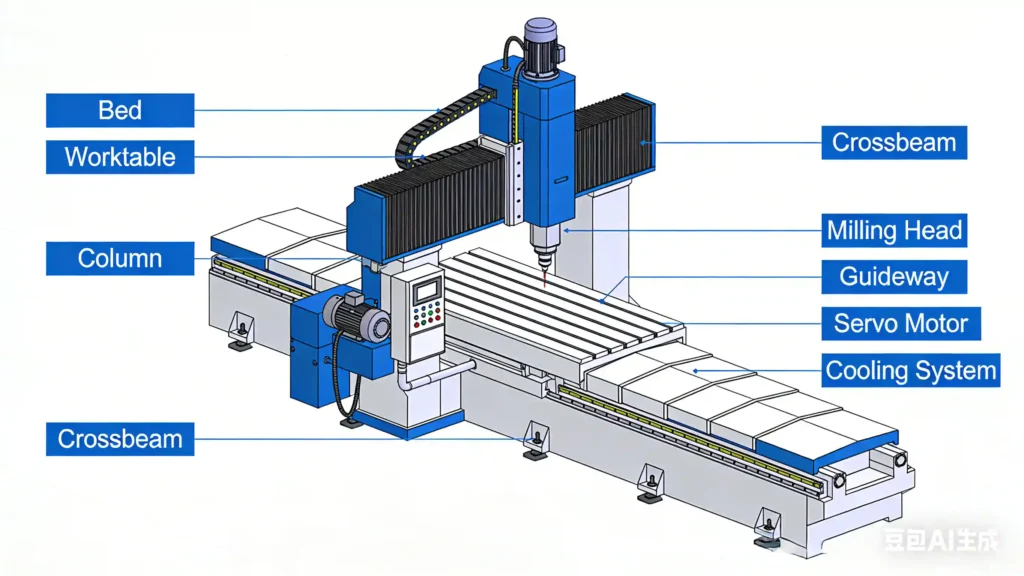
Crossbeam Maintenance for CNC Gantry Mills: Be Diligent, Don’t Slack Off
First, let’s talk about the crossbeam of the CNC gantry mills.
This component constantly moves the spindle head back and forth, making its guideways and lead screws true “model workers.” I’ve seen plenty of machinists, especially when deadlines loom, finish a job, blow away the chips, wipe it down with a rag, and walk away. Lubricant? Add some if they remember, skip it if they don’t.
Let me tell you, this is a trap.
If the guideways and lead screws run dry, it’s dry grinding. At first, you might just hear a muffled sound. Over time, you’ll feel tiny “bumps” when you run your hand over them—that’s the guideways starting to get scratched up. Later on, movement becomes jerky and uneven. How can your work be precise under those conditions?
So, every day before we clock out, even if it takes five extra minutes, we gotta get this done. Apply lubricant along the entire length of the guide rails, and don’t forget the lead screws. Then use a lint-free cloth to meticulously wipe away any metal shavings and dust from the rails. If these shavings mix with the oil, they act like sandpaper, grinding away at the rails until they eventually fail.
I had a buddy who did this a couple of years back. He was hardworking, but not smart about it. He focused on getting the job done and skipped the daily maintenance. Within two years, the crossbeam guide rails of CNC gantry mills were worn beyond repair. Replacing them costs tens of thousands of yuan, not to mention halting production and delaying orders. That really hurt. We earn every penny the hard way—no need to make life harder on ourselves.
The Column’s Story: Be Meticulous, Don’t Cut Corners
Now, about the columns of the CNC gantry mills.
They may look rigid and unmoving, but even the slightest issue can destroy the entire machine’s precision. The column’s verticality and the guide surfaces where it meets the crossbeam—these “geometric tolerances” form the foundation of our work.
My habit is this: before tackling big jobs or precision work, don’t rush to clamp the workpiece. Spend a few minutes placing a level on the worktable to check the column’s verticality. Grab a dial indicator, attach it to the spindle, and check the guideways’ parallelism. Only start working once you’re confident the measurements are right. If anything seems off, adjust it immediately—don’t think “it’s close enough.” Those few minutes upfront can save hours or even a full day of rework later.
Also, stay alert during regular operation. Keep your ears open while the machine is running. If you hear any unusual “clunking” noises coming from the column area or feel abnormal vibrations, stop the machine immediately for inspection. Nine times out of ten, it’s a loose connection or something seized up from lack of lubrication. Letting small issues fester into major problems means you’ll end up with a “open-heart surgery” on the CNC gantry mills—not worth it.
A few tried-and-true tricks: Three steps for lasting results
In our line of work, everyone has their own habits. Over the years, I’ve developed a simple three-step method for maintaining columns and crossbeams of CNC gantry mills—clumsy but incredibly effective:
1. **Warm up before starting work each day.** Just like people need to stretch after waking up, machines do too. After turning on the machine, don’t rush into work. Let it idle for five to six minutes, ideally moving the crossbeam back and forth several times within its full range. This allows the lubricant to circulate fully, loosens up all moving parts, and gives you a chance to listen for smooth operation and spot any unusual noises.
2. **Schedule a thorough cleaning weekly.** After finishing a job, find a less busy time to check each bolt connecting the crossbeam and columns for looseness. Tighten any that are loose. While you’re at it, use a cleaning agent to thoroughly remove stubborn oil residue from the guideways that cloths can’t wipe away.
3. **Monthly precision checks are non-negotiable.** Set a fixed time—like the last day of the month or the first day of the next—to thoroughly measure verticality and parallelism with gauges from start to finish. Keep detailed records. Also, check the oil reservoir levels; don’t wait for the warning light to remind you to refill.
One more thing: Don’t push your CNC gantry mills to their limits.
Finally, the most crucial—and most common—mistake.
I know deadlines are tight, bosses are pushing, and clients are demanding. But no matter how urgent it gets, don’t force your machine beyond its limits. Don’t keep increasing the cutting depth or cranking up the feed rate, thinking it boosts efficiency.
Let me tell you—this is shortening the machine’s lifespan. The column and crossbeam of the CNC gantry mills are designed with specific load limits. If you force them beyond their capacity, over time, they’ll develop invisible deformations. Once warped, precision is lost—irreversible damage. Trying to repair it later might cost a fortune, and you still might not restore it to its original state. Then crunch the numbers: does the time saved by rushing the deadline really outweigh the cost of repairing the machine?
We’re in this for the long haul. Based on your job—the material, thickness, and so on—you should have a rough idea. Choose cutting parameters that ensure efficiency without making the machine scream. That’s how the old masters do it.
Let me spill the beans for fellow craftsmen
In our CNC gantry mills business, let’s be honest—we earn our keep through craftsmanship and meticulous attention to detail. An extra glance, an extra listen, an extra wipe—these habits extend your machine’s lifespan and keep your work steady and reliable.
Don’t dismiss these as trivial matters. In our line of work, a single hair’s breadth of dimensional error can ruin an entire job. Often, it’s these seemingly insignificant details that determine whether we keep our jobs.
That’s all for today. Combine the previous two articles on selection and troubleshooting with this maintenance guide, and you’ll have my complete insights on columns and beams of the CNC gantry mills. Hope this serves as a reminder and offers some help to fellow metalworkers.
If you’ve encountered any strange issues with columns or beams of the CNC gantry mills in the workshop, or have your own unique maintenance tricks, don’t keep them to yourself. Feel free to share in the comments below—let’s figure this out together. It’s all about making our livelihoods more secure and growing together!