If you’ve been in the machining trade as long as I have—covered in metal shavings every day, staying up half the night tuning a CNC gantry milling machine until it hums perfectly, obsessing over every last bit of machining precision—you’ve definitely heard these two terms: CNC gantry milling machine and gantry machining center.
I’ve been in this business for over a decade. My calloused hands are proof, and I’ve both sold machines and repaired them with my own two hands.
Truth is, most people new to these two machines mix them up completely. And it’s no wonder—they look almost identical: same gantry frame, same heavy-duty bed, same rock-solid, built-to-take-a-beating presence.
But here’s the thing: those small differences can cost you massive downtime, wasted money, and even lost customers from choosing the wrong machine. To avoid choosing the wrong equipment, you can refer to our article on how to select a CNC gantry milling machine.
Today, let’s break down exactly what sets a CNC gantry milling machine apart from a gantry machining center—no fluff, just real shop-floor truths.
What Is a CNC Gantry Milling Machine? (A Machinist’s Firsthand Experience)
A CNC gantry milling machine is the workhorse of the shop—simple, straightforward, no fancy extras. It was built for one job: milling.
Whether it’s heavy cutting, large workpieces, or day-in-day-out slab milling, this machine is unbeatable. I’m talking face milling, slotting, profile milling—and in a pinch, it can even drill small holes.
But there’s a catch: tool changes are manual. No automated bells and whistles, just you, a wrench, and some elbow grease.
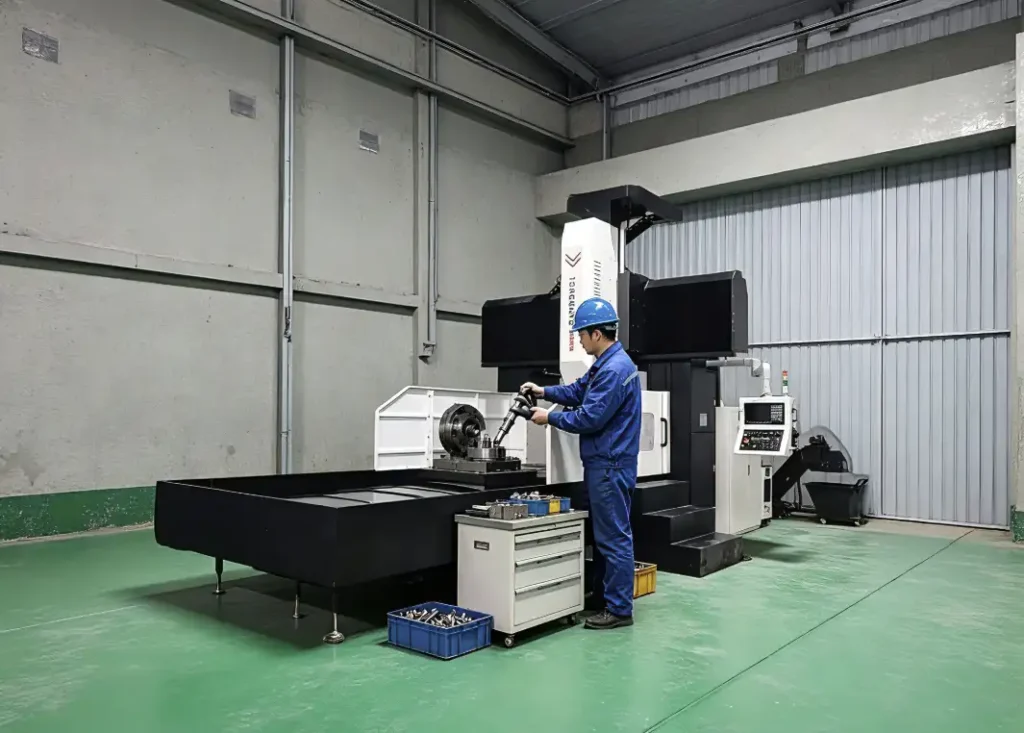
That means when you need to switch from a face mill to an end mill, you have to stop the machine, grab your wrench, change the tool by hand, and reset the tool offset.
It’s not fast, but it’s reliable—especially if your work is mostly single-process, where one tool can run for hours on end. Our shop uses CNC gantry milling machines with HT300 high-strength cast iron beds, which we’ve detailed in our previous article on CNC gantry mill bed, spindle, and drive systems.
CNC gantry milling machine with a heavy-duty bed for large workpiece machining. Note: The Alt text for the above image is underlined: (contains Focus Keyword)
Most customers buy a CNC gantry milling machine for one reason above all: rigidity. The gantry mill’s frame is rock-solid, its heavy-duty spindle holds steady even under deep cuts, and the table has exceptional load capacity.
It’s perfect for mold making, plate processing, and wind power components. For many shops, manual tool changes aren’t a big deal—why spend extra on features that’ll just collect dust?
What Exactly Is a Gantry Machining Center?
A gantry machining center is like a fully-loaded CNC gantry milling machine—same tough backbone, but packed with extras that make your life easier (and more expensive).
The biggest difference? It comes with a tool magazine and an automatic tool changer (ATC). No more stopping the machine to crank a wrench.
It handles tool changes on its own, fast and accurately. No more frustration setting tool offsets, no more wasted waiting time—hit start, and let the machine do the rest.
Depending on the model, the tool magazine can hold 16 to 60 tools. You program it to mill, drill, bore, and tap—all in one setup. The time saved is huge: no moving parts from machine to machine, one alignment, job done.
Let’s be real, though: automation doesn’t come cheap. Machining centers have a higher upfront cost and are a bit more high-maintenance.
You have to keep the tool magazine clean (it easily traps oil and sludge), regularly check ATC alignment, and make sure the software runs smoothly. Most high-end models use Fanuc CNC systems, a trusted brand with a global reputation for precision, according to Fanuc’s official website.
5 Key Differences: CNC Gantry Milling Machine and Gantry Machining Center (Shop-Floor Guide)
These are the 5 things that actually matter when you’re choosing between CNC gantry milling machine and gantry machining center. No jargon, just straight facts.
| Difference Category | CNC Gantry Milling Machine | Gantry Machining Center |
|---|---|---|
| Tool Change Method | Manual (requires operator, 1-2 minutes per change) | Automatic (ATC, 7-8 seconds per change, no operator needed) |
| Machining Capability | Specialist: Heavy cutting, large flat surfaces, single-process jobs | Generalist: Milling, drilling, boring, tapping—multi-process in one setup |
| Cost (Upfront + Maintenance) | Lower cost; durable, simple maintenance (lubrication, cleaning) | 30-50% more expensive; requires professional maintenance for ATC/software |
| Rigidity vs Flexibility | Max rigidity (thick bed, heavy spindle) for heavy-duty cutting | High flexibility (automation) with slight trade-off in brute rigidity |
| Maintenance Difficulty | Simple (any machinist can handle: check lubrication, tighten bolts) | Complex (needs skilled tech for ATC calibration, system updates) |
Can a CNC Gantry Milling Machine Be Converted to a Machining Center?
This is the most common question I get. I get it—everyone wants more for less. The answer: Yes, but only under certain conditions.
If your CNC gantry milling machine has a solid, high-quality frame, adding a tool magazine and ATC is possible. We do this for customers often, at a much lower cost than buying new.
But not all machines qualify. If your machine is too old or has a weak frame, forcing a tool magazine will cause vibration, weak milling performance, and constant ATC jams—total waste of time and money.
Which One Should You Choose between CNC gantry milling machine and gantry machining center? (Advice for Shop Owners)
There’s no “better” machine—only the right machine for your work. Here’s a quick guide to help you decide between CNC gantry milling machine and gantry machining center.
Choose a CNC gantry milling machine if:
- Your main work is heavy cutting, large flat surface machining, or single-process jobs (e.g., rough mold machining, large plate parts).
- You have a limited budget and don’t need multi-process automatic tool changes.
- You want simplicity and reliability, without the hassle of complex software and precision components.
Choose a gantry machining center if:
- Your parts are complex, requiring milling, drilling, and tapping in one setup.
- You want to boost production efficiency (40–50% improvement is realistic).
- You have sufficient budget and skilled technicians for maintenance.
- You plan to take on high-value, high-precision jobs.
Final Summary for the CNC gantry milling machine and gantry machining center
A CNC gantry milling machine is a “heavy blade without flair”—built for brute strength and durability. A gantry machining center is a “versatile speedster”—built for efficiency and multi-tasking.
Match the machine to your parts and your budget. Don’t buy unnecessary features just for show. If you’re still unsure, feel free to reach out, and we can talk through it.