
CNC gantry milling machine trial is where theory meets real workshop practice—and last Monday, a Beijing client’s visit gave us a hands-on lesson in 4.5mm patterned steel plate machining, with an unexpected bonus solution for their aluminum plate processing pain point.
They showed up with 6 pieces of 1.5m×1m, 4.5mm thick steel plates: 4 patterned steel plates (one side flat, one side textured) and 2 plain flat steel plates. Their only goal for the CNC gantry milling machine trial was clear: mill the edges of these steel plates and chamfer the circular holes on the surface.
We started with the standard magnetic disk clamping for steel parts, and it quickly became clear this setup wasn’t a fit. What followed was a test of our vacuum adsorption platform that not only solved their steel plate machining problem but also answered a question the client had been struggling with for months—how to clamp aluminum plates for CNC gantry milling. Let’s break down the real CNC gantry milling machine trial process, hard data, and the lessons we all took away.
The Client’s Challenge for CNC gantry milling machine trial: 1.5m×1m 4.5mm Patterned Steel Plate Machining
The client’s steel plates are used for heavy industrial equipment components, so flatness and machining consistency are non-negotiable.
The biggest pain points for their processing were the unique characteristics of their plates:
- 4 of the 6 steel plates have a raised, patterned surface on one side, which breaks uniform contact with any clamping system.
- All steel plates have natural warping from storage and production, a common issue with thin, large-format steel plates.
- A critical unspoken problem: the client also processes the same size 4.5mm aluminum plates, and they’d never found a reliable clamping method for them on a CNC gantry mill.
For this formal CNC gantry milling machine trial, their stated requirements were simple and clear:
- Mill the edges of 1.5m×1m, 4.5mm thick patterned/flat steel plates
- Chamfer all circular holes on the steel plate surface
- Keep the total height difference across the entire plate under 0.5mm for stable, consistent machining
We started with our go-to clamping setup for regular steel plate machining: magnetic disk adsorption. Anyone in the trade knows magnets only work for ferrous materials—we never even considered testing them on aluminum, and the client knew that too.
First Test of CNC gantry milling machine trial: Magnetic Disk Adsorption for 4.5mm Patterned/Flat Steel Plates
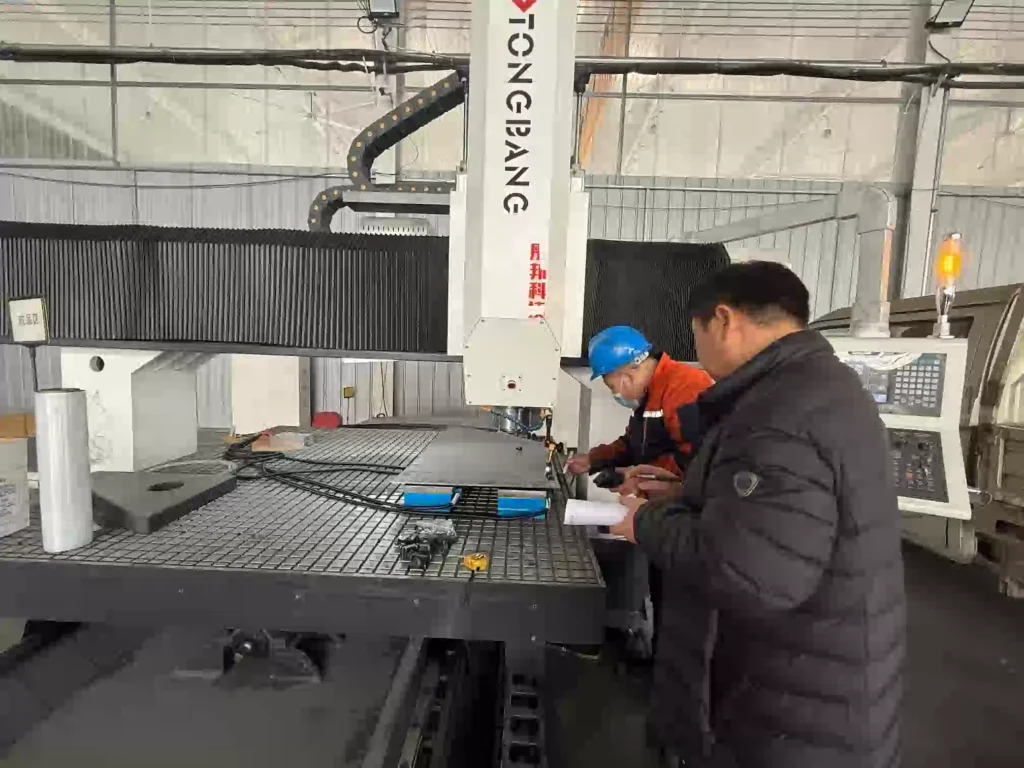
We clamped 3 of the client’s steel plates (2 flat, 1 patterned) to the magnetic disk of our CNC gantry milling machine, powered on the magnetic system, and began positioning and dotting to check the overall flatness of the plates.
The first red flag popped up immediately: the plates wouldn’t sit flat on the magnetic disk, even after adjusting the magnetic force. We measured the height difference across each plate with a dial indicator, and the data confirmed our concerns—this setup was not going to work:
| Plate Type of CNC gantry milling machine trial | Adsorption Method | Measured Height Difference |
|---|---|---|
| Flat Steel (1.5m×1m, 4.5mm) | Magnetic Disk | 1.2mm – 1.8mm |
| Patterned Steel (1.5m×1m, 4.5mm) | Magnetic Disk | 1.5mm – 2.1mm |
We tried all 6 steel plates (2 flat, 4 patterned) one by one, and the result was the same: the flat steel plates had a minimum height difference of 1.2mm, while the patterned ones were even worse, with the height difference exceeding 2mm in some areas.
The magnetic disk’s concentrated suction force pulled the thinner, more flexible areas of the steel plate tighter to the table, which only exaggerated the natural warping of the thin plate. For the patterned steel plates, the raised texture meant the magnetic contact was completely uneven—some areas were clamped solid, while others floated above the table. This would have caused severe chatter during milling, leading to inconsistent edge quality and uneven chamfers on the holes.
After 6 full tests with all the client’s steel plates, we gave them the straight workshop truth: magnetic disk adsorption wasn’t a viable solution for their warped, patterned steel plates. The only way to use magnetic clamping would be to add a pre-leveling process for the plates before they even hit the CNC gantry mill.
Second Test of the CNC gantry milling machine trial: Vacuum Adsorption Platform – A Game-Changer for the Client’s Steel Plates
After discussing the limitations of magnetic disk clamping, we proposed a solution: test the client’s steel plates on our CNC gantry milling machine’s vacuum adsorption platform. This platform distributes clamping pressure evenly across the entire surface of the plate, which we suspected would fix the flatness issue with their warped and patterned steel.
We reset the machine, thoroughly cleaned the surface of the vacuum adsorption table to ensure a tight seal, and laid down the same 3 steel plates (2 flat, 1 patterned) for testing. The results were night and day—far better than we even expected:
| Plate Type | Adsorption Method | Measured Height Difference |
|---|---|---|
| Flat Steel (1.5m×1m, 4.5mm) | Vacuum Adsorption | 0.2mm – 0.3mm |
| Patterned Steel (1.5m×1m, 4.5mm) | Vacuum Adsorption | 0.3mm – 0.5mm |
The vacuum adsorption platform’s uniform pressure spread across the 1.5m×1m plate surface held the steel plates flat without exaggerating their natural warping. Even the patterned steel plates had consistent contact with the table— the vacuum seal worked around the raised texture, and the height difference was reduced by more than 80% compared to the magnetic disk.
We ran a full production test cut on one of the patterned steel plates: milled the entire edge to the client’s specification and chamfered 12 circular holes on the surface. When we measured the finished part, the edge was straight and consistent, the chamfers were uniform, and the height difference across the machined plate stayed well within the client’s 0.5mm tolerance.
Unexpected Bonus of the CNC gantry milling machine trial: Vacuum Adsorption Solves the Client’s Aluminum Plate Machining Problem
It was after seeing the impressive vacuum adsorption results for their steel plates that the client brought up their biggest unspoken pain point: they also process 1.5m×1m, 4.5mm aluminum plates for the same industrial equipment, and they’d never found a reliable clamping method for these aluminum plates on a CNC gantry mill.
They asked us on the spot: “Your vacuum platform works great for steel—can it hold aluminum plates too?”
We had never tested this exact size aluminum plate on our vacuum platform before, so we grabbed a 4.5mm aluminum plate of the same 1.5m×1m dimensions from our workshop and ran an impromptu test. We laid the aluminum plate on the clean vacuum adsorption table, activated the vacuum system, and measured the height difference with the same dial indicator.
The result: the aluminum plate was held solidly in place with no sliding or movement, and the measured height difference across the plate was 0.25mm – 0.4mm—well within the client’s machining tolerance.
This was the breakthrough the client had been looking for. They’d been struggling to find a way to machine their aluminum plates on a CNC gantry mill for months, and what started as a steel plate CNC gantry milling machine trial had unexpectedly solved their aluminum plate clamping problem too.
We also made it clear to the client: for severely warped steel or aluminum plates (whether flat or patterned), a pre-leveling process (like a roller leveler) is still a necessary (pre-process) — even with the vacuum adsorption platform, extreme warpage will lead to a small height difference, and pre-leveling will get that gap down to 0.1mm or less for perfect machining.
Critical Takeaways from Our CNC Gantry Milling Machine Trial
After 8 hours of hands-on testing and problem-solving with the Beijing client, we walked away with 3 hard-earned workshop lessons that every shop handling large-format thin steel (and aluminum) plate machining on a CNC gantry mill should remember:
1. Magnetic clamping is not a one-size-fits-all solution for steel plates
Magnetic disks are cheap, fast, and reliable for regular flat, unwarped steel plates—but they fail miserably for warped or patterned thin steel plates. The concentrated suction force of magnets only worsens warpage in thin, large-format plates, leading to unacceptable height differences and poor machining quality.
2. Even pressure is the key to clamping warped/patterned thin plates
The vacuum adsorption platform’s biggest advantage is its uniform pressure distribution. For thin, warped, or patterned large-format plates (1.5m×1m and bigger), even low-pressure clamping across the entire surface beats high-concentration magnetic force every time. It keeps the plate flat, maintains consistent contact, and drastically reduces the height difference for precise machining.
3. Vacuum adsorption is a universal clamping solution for steel and aluminum plates
For shops that process both steel and aluminum plates (a common scenario in industrial equipment manufacturing), a vacuum adsorption platform eliminates the need for two separate clamping systems. It works reliably for both ferrous (steel) and non-ferrous (aluminum) thin plates of the same size, solving two machining problems with one setup.
Final Outcome & Client Satisfaction of the CNC gantry milling machine trial
The client left our factory with a genuine smile—this CNC gantry milling machine trial was a complete success, and it delivered far more than they’d originally come for.
They said: “We came here just to test our patterned steel plate machining on your CNC gantry mill, and we not only found a perfect clamping solution for the steel plates but also solved our aluminum plate machining problem that’s been bugging us for months. This is exactly the all-in-one solution we needed for our production.”
We also agreed to send the client a detailed pre-leveling guide for their 1.5m×1m steel and aluminum plates, linking to our earlier article on CNC Gantry Milling Machine Bed Leveling and Precision Calibration to help them get the most precise machining results from their new CNC gantry mill.
For industrial standards on large-format thin plate flatness and machining tolerances, we recommended that they refer to the ISO 10110 standard for geometric tolerances to formalize their production pre-leveling and machining specs.
Final Thoughts from a Shop Floor Veteran
This CNC gantry milling machine trial is a perfect example of what real workshop problem-solving is all about—we don’t just sell machines, we solve our clients’ actual production pain points.
We never would have tested a magnet on an aluminum plate (that’s a rookie mistake no seasoned machinist would make), and the client knew that too. What this CNC gantry milling machine trial showed is that the right clamping system can make all the difference for thin large-format plate machining, and a vacuum adsorption platform is one of the most versatile tools you can have on a CNC gantry mill for shops that process both steel and aluminum.
For any shop handling 1.5m×1m (or bigger) 4.5mm thin steel and aluminum plates—whether flat or patterned—don’t sleep on vacuum adsorption. It’s not a fancy upgrade; it’s a practical, workshop-proven solution that saves you time, reduces scrap, and solves multiple clamping problems with one setup. And always remember: pre-leveling is your friend for severely warped plates—no clamping system is a substitute for a flat blank.