
I.The “Equipment Foundation” Often Overlooked by Newcomers—The Bed of the CNC gantry milling machine
For those new to machining, let me tell you about the bed of the CNC gantry milling machine: when you first encounter a CNC gantry milling machine, nine times out of ten, you’ll be fixated on the cutting milling head and the moving worktable. No one pays special attention to the bed of the CNC gantry milling machine—that “quiet workhorse.” But let’s be honest: this seemingly bulky hunk of metal is the machine’s “foundation.” If it’s not up to par, part yield rates suffer, and the machine becomes prone to breakdowns. Today, I’ll break down the bed’s intricacies in plain workshop lingo to help you with future operation and maintenance.
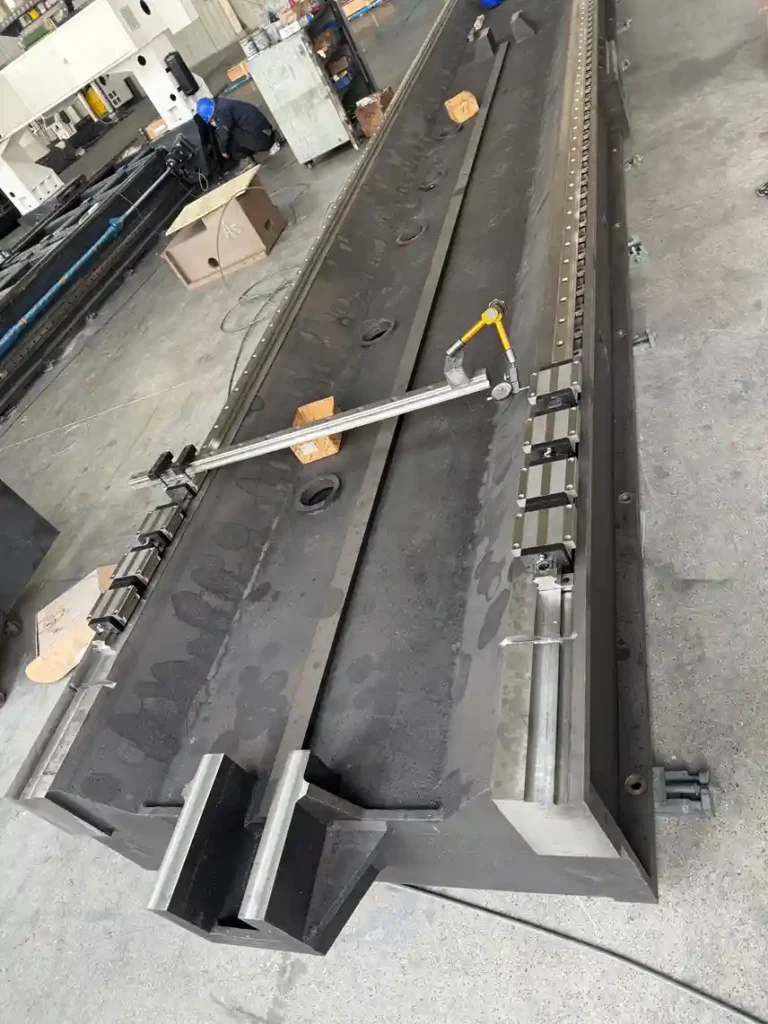
II.Core Function of the Bed: The “Supporting Foundation” for All Components
Let’s get this straight: The material of the bed of the CNC gantry milling machine is the “root” of the machine. Critical components like the column, crossbeam, and worktable all rely on it for support and stability. It’s like building a makeshift shed in our workshop—if the foundation isn’t solid, the whole thing wobbles. If the bed quality is subpar, the milling head will vibrate during cutting. Parts will either be out of tolerance or have rough surfaces. In severe cases, you’ll have to compensate for defective parts and repair the equipment. Newbies, don’t take this lightly.
III.Bed Material: Why High-Strength Cast Iron?
The bed’s material is crucial for durability. Our workshop commonly uses high-strength cast iron (HT300, HT250 grades), while heavy-duty equipment employs tougher nodular cast iron. Don’t ask why we don’t use steel plates or aluminum alloys. High-strength cast iron boasts high density and rigidity, withstanding cutting impacts while offering excellent shock absorption to minimize vibration and ensure machining precision.
IV.Critical Process: Mandatory Aging Treatment Before Shipment
Good material alone isn’t enough. The bed of the CNC gantry milling machine must undergo aging treatment before leaving the factory. Skipping this step means it won’t last long. For beginners: Cast iron develops internal “stress” after pouring. If not relieved, it will gradually deform, affecting precision. Aging treatment involves either constant-temperature static stress relief or high-temperature tempering for rapid stress elimination. Manufacturers now predominantly use artificial aging—a fast, stable method ensuring long-term bed dimensional stability.
V.Common Structural Details: Core Bed Components
Now, let’s examine everyday structural details: The bed of the CNC gantry milling machine typically features a rectangular block shape with precision-ground surfaces demanding exceptional flatness and surface finish. The top guide rail mounting surface holds the X-axis guide rail, commonly roller linear guide rails, or sliding rails. Note: Parallelism tolerance here is extremely strict—deviation must not exceed 0.02mm/m. Avoid using hard objects during cleaning.
VI.Critical Warning: Never Remove Bed Covers Arbitrarily
The protective cover on the bed surface is either made of a steel plate or retractable. Never remove it without authorization! It prevents iron chips, cutting fluid, and oil stains from damaging the guide rails or corroding the bed, while also shielding operators from injuries caused by moving parts. If the cover is damaged or loose, immediately contact maintenance personnel for repair. Safety comes first—don’t skip this step.
VII.Daily Maintenance: Don’t Skip Chip Removal Grooves and Lubrication Interfaces
Chip removal grooves are located on both sides or one end of the bed. Iron chips fall into these grooves through the gaps and are then removed by the chip conveyor. Clean them before leaving work—don’t be lazy and risk clogging the guideways. Also, check the lubrication interfaces connected to the lubrication system supplying oil to the guideways. During maintenance, inspect these points and replenish oil promptly if low—don’t wait until the guideways wear out before regretting it.
VIII.Two types of machine beds—easy for beginners to understand
There are two types of the bed of the CNC gantry milling machine:
1. Fixed-beam bed: Common in workshops, with stationary columns and a fixed crossbeam. Suitable for small to medium workpieces.
2. Moving-beam bed: Features movable columns and a crossbeam that can rise and fall. Ideal for heavy-duty workpieces.
Newcomers needn’t memorize these—just identify your workshop’s equipment for targeted maintenance later.
IX.Veteran’s Tips: Common Pitfalls in Bed Operation
Finally, a few pitfalls to avoid, all learned from veteran mistakes: First, never pile tools on the bed of the CNC gantry milling machine or strike it with hard objects to prevent damage that affects precision.
Second, use clean rags for cleaning—never scrub surfaces with hard metal shavings or sandpaper. Third, if equipment wobbles or parts are out of tolerance, it’s likely due to bed levelness issues. Don’t attempt adjustments yourself; call in a professional technician for calibration.
Summary: Understand the Machine Bed to Avoid Operational Pitfalls
In essence, the bed of the CNC gantry milling machine serves as the equipment’s “foundation.” Its material, aging treatment, and structural details demand meticulous attention. Newcomers needn’t memorize everything at once. By observing and gradually mastering these fundamentals, you’ll navigate operation and maintenance more efficiently, steadily progressing toward becoming a qualified machinist.