The CNC Gantry Milling Machine Spindle Is the Heart of Your Machine
If you ask any experienced machinist which part of a CNC gantry milling machine matters most,
Almost everyone will give you the same answer: the spindle.
The bed, column, and beam provide the strength and stability.
But the CNC Gantry Milling Machine Spindle is the part that actually does the cutting.
It doesn’t matter how strong your machine is.
If the CNC gantry milling machine spindle is weak, inaccurate, or unreliable,
Your whole machine is just a big piece of iron.
Today, I’m not going to talk about empty theories.
I’m going to share real, hands‑on knowledge about CNC gantry milling machine spindles that only people who run machines every day would know.
What Is a CNC Gantry Milling Machine Spindle, in Simple Words?
Let me put it in plain language.
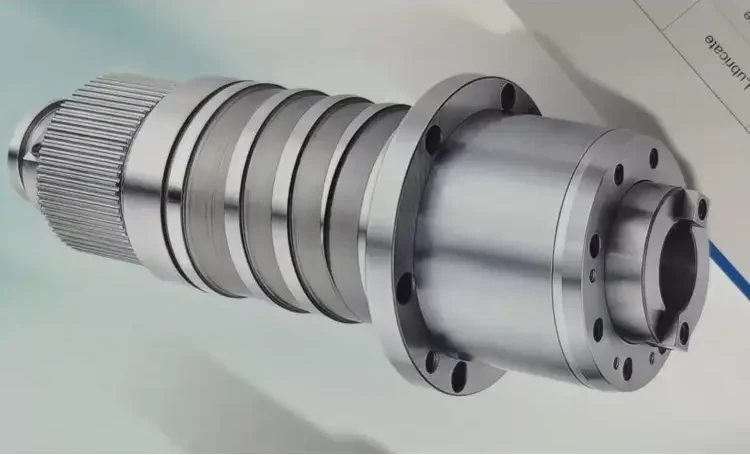
The CNC gantry milling machine spindle is the part that holds the tool and rotates at high speed.
It determines:
- How fast you can cut
- How much force you can apply
- How accurate your parts will be
- How long your machine can run without problems
In short:
Good spindle = stable work, less trouble, more profit.
Bad spindle = frequent breakdowns, poor quality, lost money.
Speed of the CNC Gantry Milling Machine Spindle: Don’t Just Chase High RPM
Many customers only look at one number: RPM.
They think higher RPM means better performance.
That’s a big mistake.
For gantry milling machines, we mostly process:
- Large steel parts
- Mold bases
- Thick plates
- Heavy roughing
What we really need is torque, not just speed.
- High speed, low torque → can’t cut hard materials
- Low speed, high torque → real heavy cutting king
If you only do aluminum or small parts, high RPM is fine.
But for a real gantry mill, torque is king.
BT40 vs BT50: Which One Should You Choose?
This is one of the most common questions.
Let me explain it like we’re talking in the workshop.
| Item | CNC gantry milling machine spindle(BT40) | CNC gantry milling machine spindle(BT50) |
|---|---|---|
| Taper Specification | Smaller taper, lighter structure | Only for small/light gantry mills |
| Suitable Machining Type | Light cutting, medium cutting, aluminum, small parts | Heavy cutting, roughing, steel, large mold, thick plate |
| Rigidity & Vibration Resistance | Medium, not ideal for heavy cuts | Very high, stable under big cutting force |
| Tool Clamping Capacity | Good for small & medium tools | Better for large, long, heavy tools |
| Speed Performance | Can reach higher RPM | Lower max RPM but higher torque |
| Torque | Medium torque | High torque, real heavy‑cutting design |
| Suitable for Gantry Mills | Only for small / light gantry mills | Standard for heavy‑duty gantry milling machines |
| Practical Suggestion | For light jobs only | Most recommended for industrial gantry mills |
In my experience:
If you are doing real industrial machining,
CNC Gantry Milling Machine Spindle BT50 is always more reliable for gantry machines.
BT40 can work, but it’s not designed for heavy loads.
One deep cut, and you risk tool pulling, vibration, or poor surface finish.
Spindle Power: The Real “Muscle”
Power is measured in kW or horsepower.
This is the muscle of your spindle.
- Low power → can’t cut deep
- High power → stable, strong, efficient
For CNC gantry mills:
- Below 11kW → light cutting only
- 15kW ~ 22kW → most common, versatile
- Above 30kW → heavy cutting, for tough materials
Don’t be fooled by fake power numbers.
Real power shows when you are cutting.
Vibration, noise, and performance tell the truth.
Spindle Motor Types: Direct Drive vs Gearbox
You’ll see two main types in gantry mills:
1. Direct drive spindle
- High speed
- Good precision
- Quiet
- Not ideal for super-heavy cutting
2. Gearbox spindle (gear head)
- Extremely high torque
- Made for heavy cutting
- Very durable
- Standard on heavy‑duty gantry mills
If you cut steel all day,
The gear spindle is the practical choice.
I’ve seen many buyers regret choosing direct drive
When they need to cut thick steel.
Cooling System: Why It Matters for Long Work Time
Spindles rotate thousands of times per minute.
They get hot.
If heat builds up:
- Spindle expands
- Accuracy drops
- Parts start to fail
- Service life becomes shorter
Good machines use:
- Water cooling
- Oil cooling
- Forced air cooling
The best spindles have constant temperature control.
This is especially important for long jobs.
A well‑cooled spindle can run all day without losing accuracy.
Sealing and Protection: Keep Dust and Coolant Out
Gantry milling creates a lot of chips, dust, and coolant.
If these get inside the spindle:
- Bearings wear out fast
- Noise increases
- Accuracy is gone
- You have to repair it often
Good spindle use:
- Multi‑layer labyrinth seals
- Air curtain protection
- Positive internal pressure
This is not expensive technology,
But it shows whether a factory is responsible.
On a dirty, dusty workshop floor,
Good sealing can double the life of a spindle.
Bearings: The Small Parts That Decide Everything
Inside every spindle are bearings.
They are small, but they control everything.
- Precision
- Smoothness
- Speed
- Service life
- Noise level
Good spindle use:
- P4 grade or higher precision bearings
- Famous brand bearings
- Proper pre‑tightening
Cheap spindles use low‑grade bearings.
They may work for a few months,
But they will quickly become noisy and loose.
For machinists,
Bearings are the hidden quality.
How to Use and Maintain the Spindle Properly
I’ll give you real, usable tips:
- Don’t start heavy cutting immediately after turning on the machine. Let the spindle warm up for a few minutes.
- Don’t use unreasonable cutting parameters. Too deep a cut will kill the spindle quickly.
- Keep tools sharp. Dull tools force the spindle to work too hard.
- Clean and lubricate regularly. Don’t let chips build up around the spindle nose.
- Check noise and vibration. Strange sounds are early warnings.
If you take care of the CNC gantry milling machine spindle, it can last many years.
Why Spindle Quality Directly Affects Your Profit
Let me be honest with you.
- Good spindle → less downtime
- Less downtime → more parts finished
- More parts → more income
- Stable accuracy → less rework
- Less rework → better reputation
One spindle breakdown can stop production for days.
The repair cost and lost profit are huge.
Buying a machine with a weak spindle just to save a little money is one of the worst decisions you can make.
Final Thoughts for Practical Machinists
The bed, column, and beam are the skeleton.
The CNC gantry milling machine spindle is the heart.
A strong skeleton without a strong heart is just a body that can’t work.
When you choose a CNC gantry mill:
- Don’t only look at size
- Don’t only look at appearance
- Don’t only look at price
Look at the spindle:
- Type
- Taper
- Power
- Torque
- Cooling
- Bearings
- Brand
These are the things that really matter.
To all my fellow machinists:
Work smart, choose smart, and make your machine earn for you.