CNC gantry mill protection & auxiliary systems are the “bodyguards” and “caretakers” of your machine. They don’t get as much attention as the spindle or CNC system, but they directly determine how long your gantry mill runs stably and how much money you make.
As a machinist who’s been running gantry mills for over a decade, I’ve seen too many shops ignore these components. A broken shield leads to damaged linear guides; poor lubrication wears out ball screws; insufficient cooling ruins workpieces; a useless chip conveyor keeps workers busy cleaning instead of producing.
Today, I’ll break down the 4 most critical components—shield, lubrication system, cooling system, and chip conveyor—from a practical perspective. No fancy theories, just real shop-floor experience to help you avoid pitfalls and keep your machine running smoothly.
CNC Gantry Mill Protection & Auxiliary Systems: What Do They Do?
Let’s keep it simple: these 4 components work together to protect your machine, extend its life, and ensure stable production.
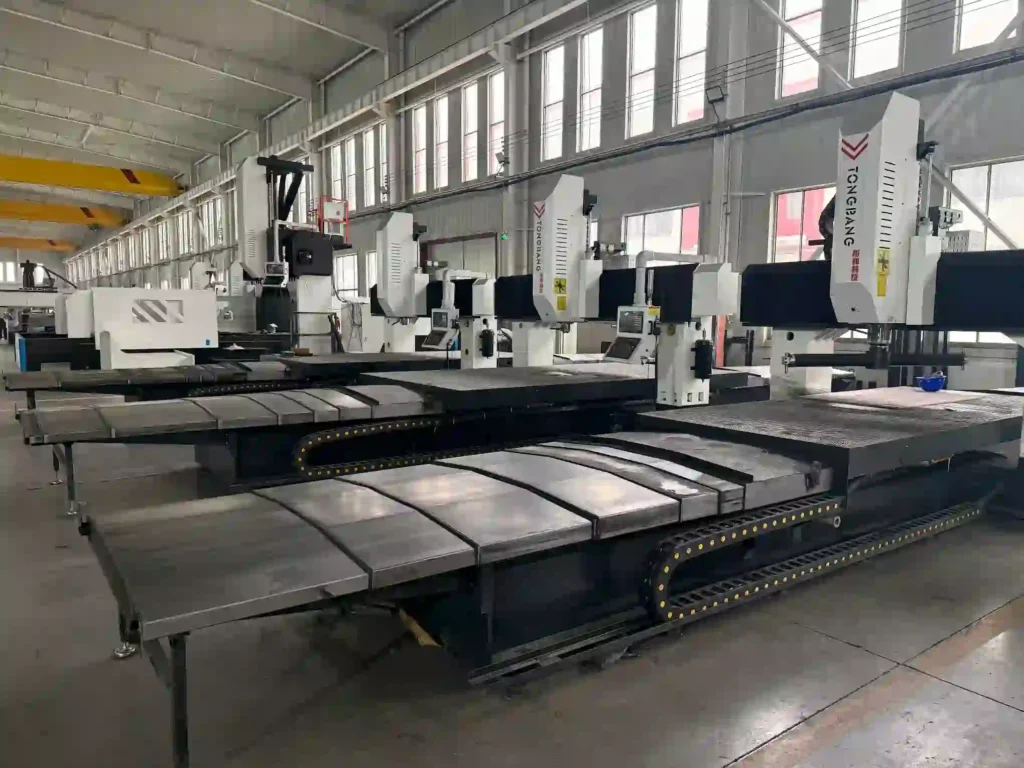
They’re not “extra parts”—they’re the reason your gantry mill can run 8+ hours a day, 5 days a week, without frequent breakdowns. For us, practical machinists, less downtime means more profit.
Each component has a clear job, and if one fails, the whole machine suffers. Let’s break them down one by one.
1. Shield for CNC Gantry Milling Machine: The First Line of Defense
The shield is the first barrier between your machine’s internal parts (linear guides, ball screws, axes) and the harsh shop environment.
Shop floors are full of dust, chips, cutting fluid, and even accidental impacts. A good shield keeps all these out.
I’ve seen a shop use a cheap, flimsy shield—after 6 months, chips got into the linear guides, causing jamming and costing $2,000 in repairs. Don’t make that mistake.
A quality shield should be full-enclosed, made of thick steel, with smooth sliding rails (so it doesn’t get stuck when the machine moves). It should also be easy to open for maintenance—no one wants to spend an hour taking apart the shield just to check a guide.
2. Lubrication System: Keep the Machine “Well-Oiled.”
The lubrication system is like the “bloodstream” of your CNC gantry mill protection & auxiliary systems. It lubricates linear guides, ball screws, and other moving parts to reduce friction and wear.
Without proper lubrication, parts rub against each other, overheat, and wear out quickly. I’ve had a ball screw fail after just 1 year because the lubrication pump was faulty—costing us 3 days of downtime and $3,500 in replacement parts.
For gantry mills, automatic lubrication systems are a must. They dispense the right amount of lubricant at regular intervals, so you don’t have to remember to oil parts manually (we’re all busy—forgetting is easy).
Look for a system with a low-lubricant alarm—this tells you when to refill, so you never run dry.
3. Cooling System: Prevent Overheating & Protect Workpieces
Heavy cutting generates a lot of heat—heat that can warp workpieces, damage tools, and even overheat the spindle. The cooling system solves this problem.
There are two main types: flood cooling and mist cooling. Which one you choose depends on what you’re cutting.
Flood cooling is great for heavy cutting of steel and mold bases—it sprays a large amount of cutting fluid to cool the tool and workpiece, and washes away chips. Mist cooling is better for light cutting or aluminum parts, as it uses less fluid and keeps the workpiece cleaner.
A common mistake: ignoring the cooling system’s filter. A clogged filter reduces cooling efficiency—we once had a workpiece warp because the filter was blocked, and we had to scrap it. Clean the filter regularly!
4. Chip Conveyor: Keep the Shop Clean & Production Moving
Gantry mills produce a lot of chips—especially during heavy cutting. A chip conveyor removes these chips automatically, so workers don’t have to stop production to clean.
I’ve worked in shops without a chip conveyor—workers spent 2 hours a day shoveling chips, which cut into production time. A good chip conveyor saves time and keeps the machine and shop floor clean.
For heavy cutting, choose a chain-type chip conveyor—it’s durable and can handle large, sharp chips. For light cutting, a belt-type conveyor works fine. Make sure it’s easy to maintain—jammed chips are a hassle to clear.
Comparison of CNC Gantry Mill Protection & Auxiliary Systems
To make it easy to choose, here’s a comparison of the key components, their functions, and what to look for when selecting them. (Image Alt Text for RankMath: CNC Gantry Mill Protection & Auxiliary Systems Comparison Table)
| Component | Core Function | Key Selection Criteria | Common Pitfalls |
|---|---|---|---|
| Shield | Protect internal parts from dust, chips, and impacts | Full-enclosed, thick steel, easy to open for maintenance | Choosing flimsy, cheap materials |
| Lubrication System | Lubricate moving parts, reduce wear | Automatic, low-lubricant alarm, consistent dispensing | Ignoring pump faults or low lubricant levels |
| Cooling System | Cool tool/workpiece, prevent overheating | Matching cooling type to material, clean filter | Clogged filters, insufficient fluid |
| Chip Conveyor | Remove chips automatically, save time | Durable, suitable for chip type, easy to maintain | Choosing a conveyor too small for heavy chip production |
Practical Case Study: Small Changes, Big Improvements
A local mold shop came to us with frequent machine breakdowns. We checked their gantry mill and found their shield was broken, the lubrication system was faulty, and the chip conveyor was too small.
We replaced the shield with a full-enclosed steel one, installed an automatic lubrication system with an alarm, and upgraded to a chain-type chip conveyor. After these changes, their downtime dropped by 80%, and their monthly production increased by 30%.
It’s not about spending a lot of money—it’s about choosing the right components for your actual needs.
The performance of CNC gantry mill protection & auxiliary systems is closely linked to the machine’s drive system. To learn how to protect your linear guides and ball screws (the core of the drive system), check our guide on Linear Guides & Ball Screws for CNC Gantry Mills.
For industry standards on CNC machine protection and auxiliary systems, refer to the official documentation from the International Organization for Standardization (ISO), which outlines best practices for machine safety and maintenance.
Conclusion
CNC gantry mill protection & auxiliary systems are the unsung heroes of your shop. They protect your investment, reduce downtime, and ensure stable production.
Don’t overlook these components—they’re just as important as the spindle or CNC system. Choose quality parts, maintain them regularly, and match them to your actual processing needs.
For us, practical machinists, a well-maintained machine is a profitable machine. Take care of these 4 components, and your gantry mill will reward you with years of reliable service.