
CNC Gantry Milling Machine Ball Screws are the core transmission parts that directly decide the positioning accuracy, cutting stability and service life of your gantry milling machine. They work closely with linear guides, the “feet” of the machine, to form the 3-axis drive system connecting the machine’s rigid skeleton and cutting heart (spindle).
The Precision Dilemma: Most machine shop owners and engineers face the same headache: How to balance high positioning accuracy with a limited budget. Choosing a screw that is too “cheap” leads to vibration and thermal deformation during heavy cutting, while over-specifying (choosing C3 when C5 suffices) wastes thousands of dollars. Whether you are dealing with backlash issues, unexpected noise, or rapid precision loss in your X-axis, this guide provides the technical clarity to help you make a data-driven decision.
Without high-quality ball screws, even the strongest machine structure cannot achieve stable heavy cutting or long-term precision retention. The accuracy difference between two gantry mills of the same model is mostly caused by the quality and matching of ball screws.
This guide breaks down 7 key points about CNC gantry milling machine ball screws, including types, parameters, axis matching and maintenance, all summarized from front-line machining experience to help you avoid selection and use pitfalls.
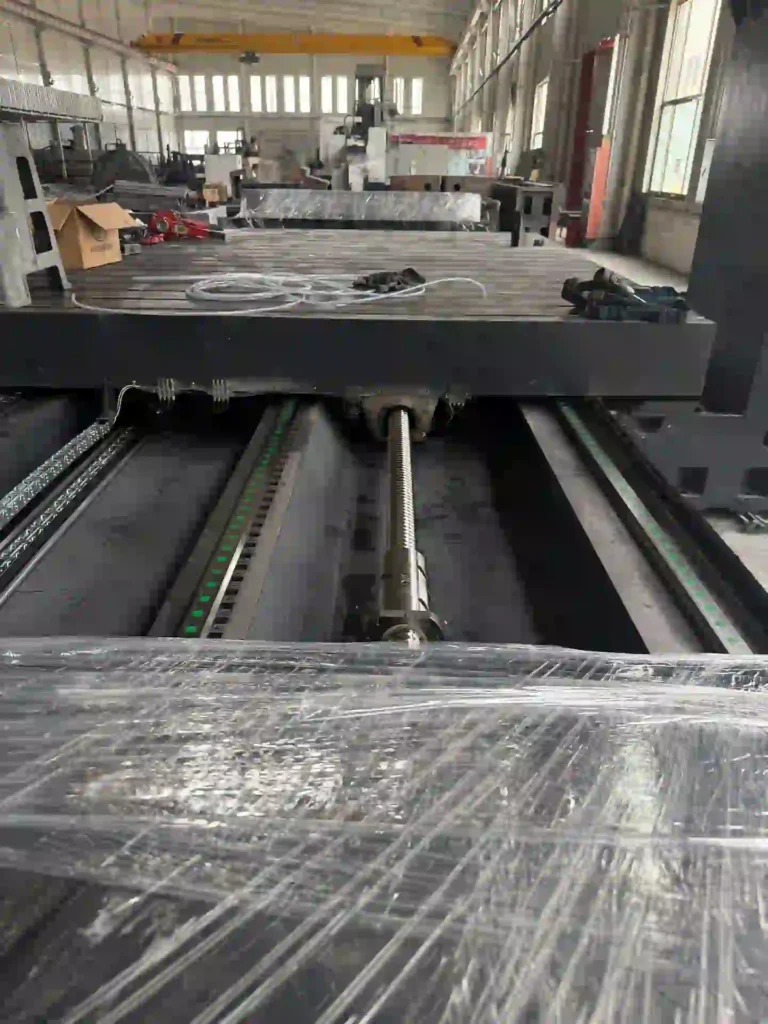
What Are CNC Gantry Milling Machine Ball Screws?
Ball screws convert rotational motion into linear motion with minimal friction, which is key to the precise movement of the gantry mill’s X, Y, Z axes. Unlike ordinary lead screws relying on sliding friction, they use rolling balls to minimize friction.
They carry the heavy load of the worktable, saddle and ram during milling, boring and drilling, bearing the main transmission force and positioning task for all three axes.
Compared with ordinary lead screws, ball screws have higher efficiency (90%-95% vs 30%-40%), higher accuracy and lower wear, saving motor power and reducing energy consumption.
For heavy-duty CNC gantry milling machines, ball screws are the “backbone” of the whole machine; a weak ball screw will cause vibration, positioning deviation, and even spindle or worktable damage.
We have explained the basic matching of guideways and screws in our earlier article: Linear Guides and Screws for CNC Gantry Mill.
2 Main Types: Ground vs Cold Rolled CNC gantry milling machine Ball Screws
CNC gantry milling machines mainly use two kinds of ball screws: ground and cold rolled. Produced by different processes, they differ in accuracy, performance and applicable scenarios, so choosing the right type based on processing needs is critical.
Ground Ball Screws
Ground ball screws are formed by rolling and then precision ground on CNC grinding machines, with strict production processes ensuring high precision and stability.
They have extremely high accuracy, usually C3, C5 or higher; C5 is the standard for heavy-duty gantry mills, while C3 is for high-end mold and ultra-precision part processing.
Featuring excellent rigidity, low noise and long precision retention, they are suitable for heavy cutting, high-precision mold machining and long-term industrial use.
Cold Rolled Ball Screws
Cold rolled ball screws are formed by direct extrusion at room temperature, with a simpler production process, lower cost and shorter lead time (30%-50% cheaper than ground screws of the same specification).
Accuracy is generally C7–C10, enough for general semi-finishing of ordinary workpieces, but not ideal for high-speed heavy cutting or long-term precision applications.
Comparison Table
| Item | Ground Ball Screws | Cold Rolled Ball Screws |
| Accuracy Grade | C3–C5 | C7–C10 |
| Surface Roughness | Ra ≤ 0.4 μm | Ra ≥ 0.8 μm |
| Rigidity | Very High | Medium |
| Service Life | Long (5-10+ years under proper maintenance) | Normal (2-5 years under normal use) |
| Price | Higher | Lower |
| Best For | Precision gantry mills, heavy cutting, high-end mold processing | General gantry mills, semi-finishing, low-precision processing |
For more professional parameter standards, you can refer to the official data from the leading ball screw manufacturer: HIWIN Ball Screw .
8 Core Parameters of CNC Gantry Milling Machine Ball Screws
When selecting CNC gantry milling machine ball screws, you must check 8 key parameters, as each directly affects the machine’s performance, positioning accuracy and service life.
1. Screw Diameter
Larger diameter means higher rigidity and less bending under heavy load; long-travel X-axis screws usually use larger diameters to avoid deflection.
2. Lead
Lead determines moving speed and positioning accuracy: small lead for higher accuracy and lower speed, large lead for faster speed and slightly lower accuracy.
3. Accuracy Class
C3: ultra-precision for high-end mold machining (lead error ≤0.008mm/m); C5: high precision (standard for heavy gantry mills, lead error ≤0.018mm/m); C7: general precision for basic workpiece machining (lead error ≤0.050mm/m).
4. Preload Structure
Double nut preload is mostly used to eliminate backlash between the screw and nut, improving positioning accuracy and cutting stability.
5. Support Method
Fixed-fixed support is used for long travel axes to reduce thermal deformation; fixed-simple support is used for short vertical axes for easier installation and maintenance.
6. Length & Aspect Ratio
Overly long screws may sag, so diameter must be increased accordingly; the aspect ratio (length/diameter) should generally not exceed 30.
7. End Machining
End structure must match the servo motor, coupling and reducer, with common structures including cylindrical, threaded and flange ends.
8. Material & Hardness
High-quality bearing steel (such as SUJ2) with quenching treatment (HRC 60-62) ensures wear resistance and long service life.
X/Y/Z Axis Ball Screw Matching for CNC Gantry Mills
CNC gantry milling machine ball screws are configured differently for X, Y and Z axes, with targeted selection based on their movement directions, load-bearing conditions and precision requirements.
X-axis
Long travel and heavy worktable load require large-diameter ground screws with fixed-fixed support and pre-tension, usually C5 or C3 grade with diameter ≥63mm.
Y-axis
Bearing the main cutting force, it needs high rigidity, so a medium lead, C5 grade screw (diameter 50-63mm, lead 10-20mm) is suitable.
Z-axis
Vertical movement requires an anti-drop function, so it should match a brake motor and rigid C5 grade screw (diameter 40-50mm) to prevent sliding.
How to Judge Quality of CNC Gantry Milling Machine Ball Screws
Many buyers only focus on price, but quality can be quickly judged from 4 simple points without professional testing equipment.
1. Surface Finish
Ground screws have fine, smooth and even grinding lines; cold rolled screws have a bright extruded surface with uniform lines.
2. Precision Report
Formal manufacturers provide a precision inspection report for each screw, indicating accuracy grade, lead error and surface roughness.
3. Brand & Origin
Taiwan and German brands (THK, NSK, HIWIN, DTK) have strict quality control, ensuring high accuracy and long service life; ordinary brands often cut corners.
4. Matching Bearings
High-end screws use imported bearings (NSK, SKF) to improve stability and smooth operation.
4 Maintenance Tips to Extend Ball Screw Life
Proper maintenance can double the service life of ball screws and maintain machine accuracy, reducing maintenance costs and downtime.
1. Automatic Lubrication
Use a centralized lubrication system with quantitative oil supply to avoid insufficient or excessive lubrication.
2. Dust and Chip Protection
Install intact protective covers to prevent iron chips and dust from entering the screw.
3. Avoid Collision
Use axis limit protection to prevent impact damage to the screw.
4. Regular Inspection
Check clearance, noise and lubrication status every 3 months, handling abnormalities promptly.
Final Checklist for Selecting CNC Gantry Milling Machine Ball Screws
Use this checklist to confirm the selected ball screws meet your needs:
1. Choose ground screws (C3/C5) for high-precision machining; C7 cold rolled screws for ordinary semi-finishing.
2. Confirm lead and diameter based on travel and load.
3. Match proper support and preload structure (fixed-fixed for long strokes, double nut preload).
4. Use branded screws with quality inspection reports.
5. Maintain regular lubrication and protection.
Following these rules ensures stable performance of your CNC gantry milling machine ball screws for years.
Frequently Asked Questions (FAQ)
Q1: What is the main difference between C3, C5, and C7 ball screws?
- A: The difference lies in the lead error per 300mm. C3 is ultra-precise (error ≤ 0.008mm), ideal for high-end mold making. C5 is the industry standard for heavy-duty CNC gantry mills (error ≤ 0.018mm), offering a balance of cost and precision. C7 is cold-rolled (error ≤ 0.050mm) and best suited for general-purpose semi-finishing.
Q2: How often should I lubricate my CNC gantry milling machine ball screws?
- A: For machines in a standard 8-hour shift, we recommend checking the automatic lubrication system daily. A manual deep cleaning and re-greasing should be performed every 3 to 6 months, depending on the workload and the environment (dust/chips).
Q3: Can I replace a ground ball screw with a cold-rolled one to save costs?
- A: It is not recommended for the main axes of a precision gantry mill. Cold-rolled screws lack the surface hardness and geometric consistency of ground screws, which will lead to lower rigidity and a much shorter service life under heavy loads.
Q4: Why is my CNC ball screw making a grinding noise?
- A: This is usually caused by three factors: lack of lubrication, ingression of metal chips due to a damaged protective cover, or worn-out internal steel balls. If you hear grinding, stop the machine immediately to prevent permanent damage to the screw shaft.