
If you are engaged in large-scale mechanical processing, mold manufacturing, heavy equipment parts production, and metal plate deep processing industries, you must be very familiar with the Fixed Beam CNC Gantry Machine. This type of gantry processing equipment has gradually become the mainstream configuration in medium and large processing factories due to its stable operation, strong bearing capacity, and excellent machining accuracy. Compared with other common gantry machine tools on the market, its structural design is more in line with the actual processing demands of heavy cutting and long-term continuous production, so it is widely recognized by front-line processing technicians and factory owners.
- 1. Core Concept Split of Fixed Beam CNC Gantry Machine
- 2. Two Core Industry Questions & Professional Practical Answers
- 3. Core Practical Benefits of Choosing a Fixed Beam CNC Gantry Machine
- 4. Standard Operation Steps for Fixed Beam CNC Gantry Machine Processing
- 5. Three Real Production Application Effects & Practical Feedback
- Final Summary
1. Core Concept Split of Fixed Beam CNC Gantry Machine
To fully use the Fixed Beam CNC Gantry Machine well, we first need to sort out its core structural logic and basic operating principles, instead of only understanding the superficial name.
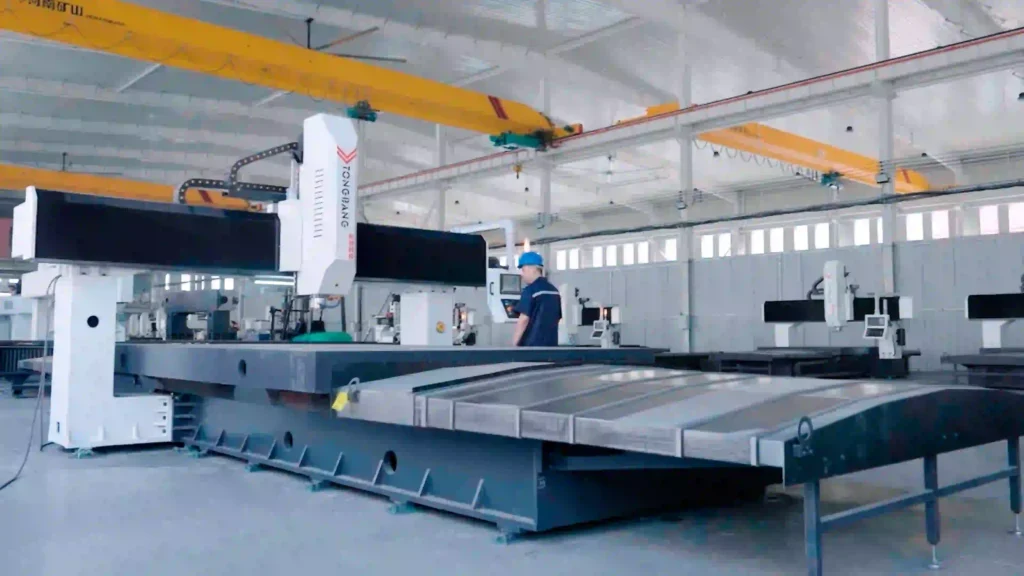
Literally speaking, a fixed beam means the main horizontal beam of the whole gantry frame is fixed and cannot move left and right or back and forth. The two vertical supporting columns are firmly poured and installed on the thickened integral cast iron bed, and the beam is locked between the two columns to form an integrated, closed, rigid frame. This is the most essential difference between a fixed beam CNC gantry machine structure and a moving beam gantry machine.
In terms of operation mode, the main moving part of the Fixed Beam CNC Gantry Machine is the processing worktable installed at the bottom. The worktable carries all workpieces and moves freely along the X-axis and Y-axis according to the programmed route. The spindle head responsible for drilling, milling, boring, and tapping only moves up and down along the fixed beam to complete Z-axis feed cutting.
In actual production configuration, a standard fixed beam CNC Gantry machine is equipped with high-rigidity box guide rails or heavy-duty roller linear guide rails, high-precision ball screw transmission pairs, and mainstream industrial CNC control systems, like Siemens. The overall body adopts a multi-layer reinforcing rib design, which can effectively disperse the vibration force generated during heavy cutting and avoid body deformation caused by long-term load bearing.
From the perspective of practical application positioning, this machine tool is not designed for small precision parts with high-speed cutting demand. Its core positioning is to solve the processing difficulties of oversized size, super heavy weight, and high flatness requirement workpieces, and focus on meeting the batch processing demand of large workpieces in heavy industry fields.
2. Two Core Industry Questions & Professional Practical Answers
In daily workshop communication and customer equipment selection consultation, there are two most frequently asked questions about the Fixed Beam CNC Gantry Machine. I will answer them with actual processing experience, without empty theoretical content.
Question 1: Under the same processing environment, is a fixed beam CNC gantry machine more practical than a moving beam type?
Practical Answer: For most heavy-duty, large workpiece processing scenarios, a fixed beam structure is definitely more practical and more stable. The moving beam gantry machine needs to drive the whole heavy beam to move synchronously during operation, which will produce obvious inertia impact and running vibration in the process of fast start and stop. Long-term use will lead to increased wear of transmission parts and gradual deviation of positioning accuracy.
The Fixed Beam CNC Gantry Machine abandons the heavy beam moving design; the frame remains static all the time, only the light-weight worktable moves. The whole machine runs with small vibration, stable cutting force, and the error value generated in repeated processing is extremely low. Whether it is rough milling with large cutting depth or finish milling with high flatness requirements, it can maintain a stable machining effect. The only slight disadvantage is that the floor area is slightly larger, which is completely negligible for processing factories with sufficient site space.
Question 2: What kinds of workpieces are completely not suitable for processing with a fixed beam CNC gantry machine?
Practical Answer: First of all, ultra-small miniature hardware parts, small die accessories, and high-frequency fast cutting parts are not suitable. The running stroke and response speed of fixed beam equipment are biased towards stability rather than high speed, and it cannot match the high-efficiency production rhythm of small parts. Secondly, ultra-thin, easy-to-deform sheet metal parts are also not recommended. The heavy worktable clamping method is easy to cause workpiece extrusion deformation, and it is more suitable to choose special plate processing equipment.
Its most matching processing objects are large mold bases, engineering plastic thick plates, aluminum alloy large structural parts, wind power equipment shells, mechanical equipment bottom frames, and other large heavy workpieces with stable material texture and a single processing route.
3. Core Practical Benefits of Choosing a Fixed Beam CNC Gantry Machine
Many processing factories have replaced old equipment with Fixed Beam CNC Gantry Machine in recent years, fundamentally because it can bring tangible production benefits and cost-saving effects to the workshop.
First of all, the overall machining accuracy is more stable, and the qualified rate of finished products is significantly improved. The integrated fixed frame effectively controls the machine tool deformation error, and the whole machine positioning accuracy can be stably controlled within 0.01mm, and the repeated positioning accuracy is higher. In batch processing, the size difference between front and rear workpieces is extremely small, which greatly reduces the rework rate caused by accuracy deviation.
Secondly, the equipment’s load-bearing performance is strong, and the processing range is wider. The thickened worktable can bear heavy workpieces of 10 tons to 30 tons, and can complete one-time clamping and multi-surface forming processing, avoiding multiple positioning errors caused by repeated workpiece handling, and greatly shortening the overall processing cycle.
Thirdly, the later maintenance cost is low, and the service life is longer. The fixed beam structure has fewer vulnerable moving parts, the wear speed of guide rails and screws is slower in daily use, and the daily maintenance only needs regular lubrication and dust cleaning. Compared with the moving beam structure with a complex transmission structure, it can save a lot of equipment maintenance funds and maintenance time every year.
In addition, the equipment compatibility is strong, which can be matched with various auxiliary fixtures, universal processing tools, and automatic feeding accessories. It can quickly switch processing schemes according to different customer order demands, and greatly improve the flexible production capacity of the whole workshop.
4. Standard Operation Steps for Fixed Beam CNC Gantry Machine Processing
Combined with front-line workshop actual operation experience, I sort out the most standardized and efficient use steps of the Fixed Beam CNC Gantry Machine, which new operators can follow directly to avoid operational errors.
Step 1: Complete pre-processing inspection and parameter confirmation. Check whether the fixed beam frame, guide rail surface, and worktable are clean and free of iron filings and sundries. Confirm the overall weight, external size, and processing thickness of the workpiece, and verify whether the equipment load-bearing limit and effective processing stroke meet the production demands.
Step 2: Select reasonable clamping tools and complete stable workpiece fixing. According to the workpiece material and appearance structure, choose a T-slot pressure plate, a fixed fixture, or a vacuum adsorption fixing mode. Ensure the workpiece is stressed evenly after clamping, no shaking or tilting, and reserve sufficient space for tool cutting movement.
Step 3: Match the processing system and set cutting parameters. Connect the compiled processing program to the CNC system, select the matched spindle speed, feed speed, and cutting depth according to workpiece hardness and processing technology. For hard alloy materials, appropriately reduce the feed speed; for light alloy plates, reasonably increase the operating efficiency.
Step 4: Carry out an empty running test and tool setting calibration. Before formal processing, start the equipment for idle stroke running to check whether there is abnormal noise and running jam of each moving part. Complete accurate tool setting calibration to ensure that the tool processing starting point is consistent with the program data, and eliminate size errors caused by tool setting deviation.
Step 5: Start trial cutting, processing, and real-time status observation. First, process the test sample area, after detecting that the size and flatness meet the drawing standards, start formal batch processing. In the processing process, always pay attention to the cutting vibration and spindle running status, and adjust the parameters in time if abnormal conditions occur.
Step 6: Post-processing finishing and equipment daily maintenance. After all processing tasks are completed, shut down the equipment in order, clean up all iron filings and cutting fluid residues inside the equipment, apply protective lubricating oil to the guide rail and transmission parts, and make daily use records to lay a foundation for stable use next time.
5. Three Real Production Application Effects & Practical Feedback
After many medium and large processing factories put the Fixed Beam CNC Gantry Machine into actual production, they have obtained very obvious practical production effects, which are all real feedback from the industry.
First application effect: The automobile large mold processing factory optimized production efficiency. After replacing the original old moving beam equipment with a fixed beam gantry machine, the workpiece finish machining flatness is more unified, the product scrap rate is reduced from 7.5% to less than 1.5%, and the comprehensive processing efficiency of a single large mold is increased by nearly 23%, which effectively shortens the customer order delivery cycle.
Second application effect: The new energy equipment parts processing workshop improves processing stability. When processing large wind power structural parts with super heavyweight, the Fixed Beam CNC Gantry Machine runs stably for a long time without frame shaking and position offset. The one-time forming qualified rate of workpieces reaches more than 98%, and the frequency of later size correction is greatly reduced.
Third application effect: The engineering plastic and non-metal plate deep processing enterprise expands its business scope. Relying on the strong stability and large stroke advantages of fixed beam equipment, the factory successfully took over more oversized plate processing orders. The equipment can adapt to various non-metal cutting and grooving technologies, effectively expanding the enterprise’s external order receiving scope and market competitiveness.
Final Summary
In the current large-scale heavy-duty mechanical processing industry, the Fixed Beam CNC Gantry Machine has become an indispensable core processing equipment with its stable rigid structure, strong load-bearing capacity, low failure rate and wide applicable scenarios. Whether it is medium-sized processing workshops expanding production scale or large factories optimizing high-precision processing lines, choosing scientific and reasonable fixed beam CNC gantry machine configuration and standardized operation methods can steadily improve overall production benefits.