
CNC Gantry Mill Bed Structure and Long-Term Precision Stability determine the overall machining accuracy, service life, and operational reliability of large gantry milling equipment. As the foundational carrier of all moving and cutting components, the mill bed bears static load, dynamic impact, and long-term thermal deformation during continuous operation.
Many industrial users overlook the structural rationality of the gantry mill bed. They only focus on spindle power, feed speed, and cutting efficiency during equipment selection and daily use. This one-sided selection and usage habit easily results in gradual precision attenuation after 1-2 years of high-intensity continuous processing. Stable long-term precision is not achieved by frequent post-processing calibration or parameter correction. It fundamentally relies on standardized bed structure design, high-quality material configuration, and stress elimination technology at the initial manufacturing stage.
To meet international high-precision machining accuracy standards, all structural design and precision detection of gantry mill beds must strictly comply with ISO 230-1:2012 machine tool geometric accuracy test specifications. This latest confirmed authoritative standard (reviewed and valid in 2023) specifies unified test methods for machine tool geometric accuracy under no-load or quasi-static conditions. It clearly defines professional detection criteria for bed deformation, flatness deviation, structural consistency, and long-term precision stability of CNC milling machines, which is the core basis for evaluating bed comprehensive performance.
1. Basic Composition of CNC Gantry Mill Bed Structure and Precision Foundation
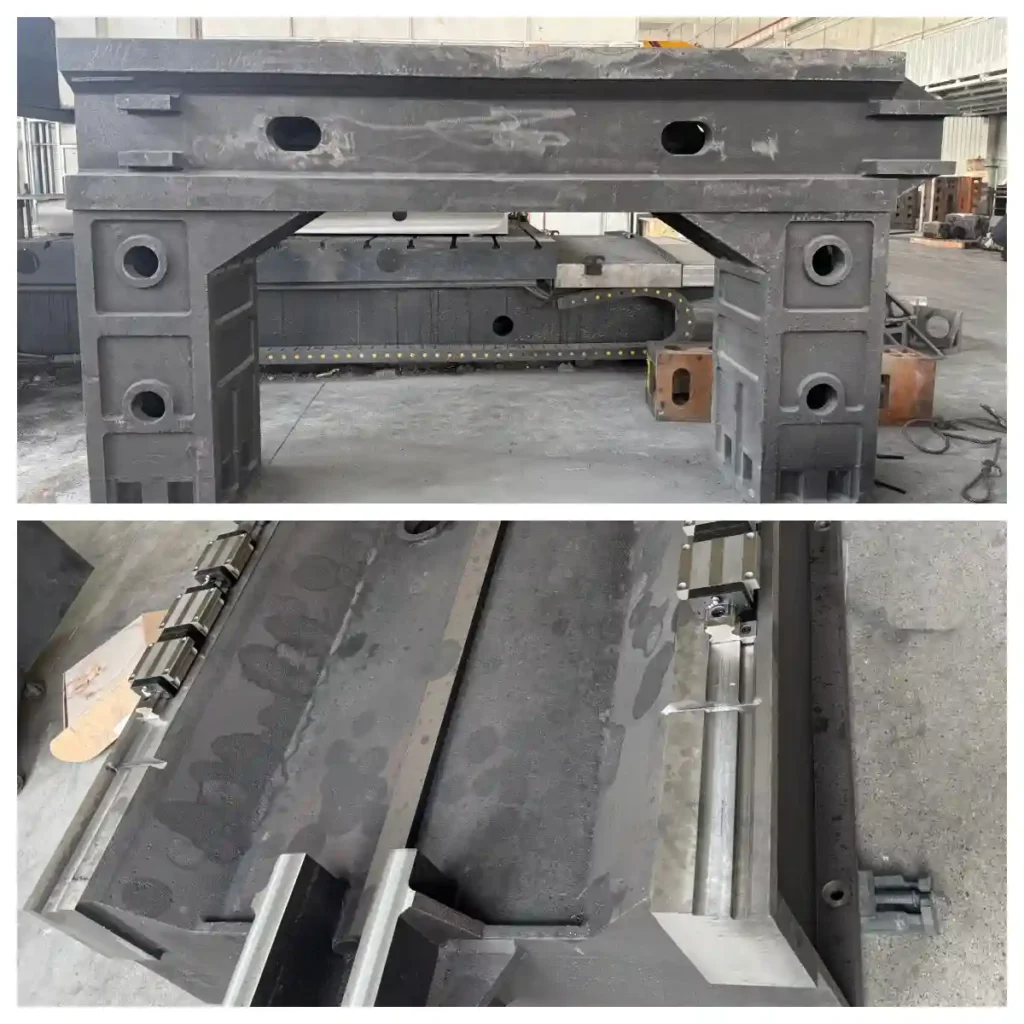
CNC Gantry Mill Bed Structure and Long-Term Precision Stability are fundamentally supported by three core structural components: integral cast base, reinforced rib layout, and linear guide mounting base. Each part works synergistically to resist external deformation and maintain dimensional stability.
The bed of the CNC gantry milling machine is mostly made of high-strength gray cast iron HT300, which is the mainstream material for high-end large-scale CNC gantry mills. This material features a low thermal expansion coefficient, strong vibration-damping performance, and excellent structural stability. It can effectively absorb high-frequency cutting vibration generated by high-speed milling and heavy-duty cutting. It also avoids tiny micro-displacement and position deviation of the worktable during continuous processing, laying a solid foundation for stable machining accuracy.
The internal reinforced rib structure adopts a mature grid-like hollow design, which is a key optimized structure for balancing rigidity and weight. It greatly reduces the overall self-weight of the bed while ensuring sufficient structural rigidity and bearing capacity. This structure effectively avoids uneven stress distribution and local structural fatigue caused by long-term unilateral load and intermittent heavy processing. It is the core structural design to prevent permanent structural deformation and precision failure of the bed.
The guide rail mounting surface of the bed undergoes multiple artificial aging treatments and ultra-precision manual scraping processes. This elaborate manufacturing process completely eliminates residual internal stress generated during casting and machining. It ensures the flatness of the mounting surface is strictly controlled within 0.02mm/m, and guarantees the parallelism and verticality of the guide rail installation. These precise manufacturing indexes lay a reliable hardware foundation for long-term precision retention of the gantry mill.
For professional maintenance and structural optimization of machine tool beds, you can refer to CNC Machine Tool Bed Precision Maintenance and Deformation Repair Technology to realize long-term stable equipment operation.
2. 5 Key Factors Affecting CNC Gantry Mill Bed Long-Term Precision Stability
The long-term precision attenuation of CNC gantry mills is never caused by a single structural or environmental factor. It is the cumulative result of the combined action of bed structure design, material performance, manufacturing process, operating environment, and daily use habits. The following five core factors are the most critical indicators that directly determine the service precision, life, stability duration, and failure probability of the gantry mill bed.
| Influencing Factor | Specific Impact | Stability Optimization Scheme |
|---|---|---|
| Bed Material Performance | Poor material rigidity leads to elastic deformation; unaged materials produce later stress release | Adopt HT300 cast iron, double aging treatment |
| Internal Rib Layout | Unreasonable rib spacing causes uneven stress and local sinking | Grid symmetric rib layout, equal stress design |
| Thermal Deformation Resistance | Long-term processing heat accumulation causes bed warping and flatness deviation | Reserve heat dissipation gaps, optimize structural heat conduction |
| Assembly Precision | Guide rail and screw mounting deviation accumulates long-term positioning errors | Precision scraping + laser calibration during assembly |
| Daily Operation Load | Long-term overload processing accelerates structural fatigue deformation | Standardize processing load, regular precision detection |
3. Structural Optimization Strategies for Sustained Precision Stability
To maintain long-term precision stability of CNC gantry mills, passive precision calibration is far less effective than active structural optimization. The bed structure needs targeted personalized optimization according to actual processing scenarios, including heavy-duty cutting, high-speed finishing, and long-term batch production. Rigidity enhancement, vibration resistance improvement, and thermal deformation resistance upgrading are the three core optimization directions for permanent precision stability.
First, adopt an integral one-piece casting structure. Split bed structures are prone to joint gap changes after long-term vibration. The integral casting effectively avoids splicing errors and improves overall structural integrity.
Second, optimize the asymmetric load resistance design. Gantry mills often undertake large-scale asymmetric workpiece processing. The local thickened structure and dense rib layout on the stressed side can balance unilateral stress displacement.
Third, strengthen the overall thermal stability design of the bed. Long-term continuous operation will generate massive cutting heat, motor operating heat, and friction heat, which will accumulate inside the equipment. Setting independent heat dissipation cavities and heat conduction grooves inside the bed can effectively isolate internal heat sources. It avoids thermal stress concentration and prevents irreversible structural warping and deformation of the bed caused by long-term heat accumulation.
4. Daily Maintenance to Extend Bed Precision Service Life
Excellent inherent structural design and high-precision manufacturing technology still need matching standardized daily maintenance to lock long-term precision stability. After statistics, more than 80% of gantry mill precision attenuation and failure problems stem from neglected daily protection and irregular operation, rather than inherent structural defects of the bed itself.
Regularly clean the guide rail mounting surface and bed sundries to avoid hard particle friction, causing surface wear. Keep the equipment operating environment at a constant temperature to reduce thermal expansion and contraction fluctuation of the bed structure.
Enterprises should conduct quarterly professional precision calibration and performance testing. Technicians need to detect bed flatness, guide rail parallelism, and overall structural deformation in real time. Timely correction of tiny running deviations can effectively avoid cumulative precision loss. This simple maintenance method can maximally ensure long-term stable and consistent machining accuracy of CNC gantry mills.
5. Conclusion
CNC Gantry Mill Bed Structure and Long-Term Precision Stability are the core competitiveness of large gantry milling equipment. Reasonable structural design, high-quality material selection, standardized processing technology, and scientific daily maintenance together constitute the precision guarantee system.
Only by optimizing the bed structure from the source, selecting high-quality structural materials, adopting standardized precision processing technology, and cooperating with scientific standardized use and daily maintenance can CNC gantry mills maintain stable micron-level machining accuracy for a long time. This perfect precision guarantee system can fully meet the strict high-precision processing needs of mold manufacturing, aerospace equipment, precision machinery, and automotive parts industries.