
So you’ve finally pulled the trigger on a CNC gantry machining center. Good choice—these machines are absolute beasts for large-scale, high-precision work. But here’s where the real conversation begins: How long until it’s sitting on your floor and actually cutting chips?
Let me be straight with you. CNC Gantry Machine Delivery Time isn’t just one number. It’s a three-stage marathon: getting the machine built, getting it to your port, and then getting it running. After years of helping shops worldwide set these up, I can walk you through exactly what to expect.
Let’s break it down.
First: What’s Actually Changing the CNC Gantry Machine Delivery Time?
Before we talk timelines, you need to know what pushes those numbers up or down.
- First: What’s Actually Changing the CNC Gantry Machine Delivery Time?
- Ocean Freight: The Part Nobody Talks About CNC Gantry Machine Delivery Time
- Installation – Where the Real Work Begins (CNC Gantry Machine Delivery Time Stage 2)
- Overseas Commissioning – Making It Actually Run
- Common Headaches (And How to Avoid Them)
- How to Choose a Supplier That Delivers (Literally)
- Realistic Timeline Summary
- Final Thoughts
Standard vs. Custom Builds Due To Different CNC Gantry Machine Delivery Time
A standard machine? Pretty straightforward. Most suppliers will deliver within 45 working days after receiving your deposit. That’s for off-the-shelf configurations—think common working areas like 1525 or 2040, standard spindle setups, nothing too fancy.
But if you need something custom? That’s a different story. Custom configurations typically run 60 to 120 days. And I’ve seen complex builds stretch even longer when you’re talking about 5-axis heads or oversized tables.
What Factors Matter Most for CNC Gantry Machine Delivery Time?
Here’s what actually drives the timeline:
- Core component availability – CNC systems (Fanuc, Siemens), spindles, ballscrews, linear guideways. These aren’t sitting on a shelf somewhere.
- Factory production schedule – Good manufacturers run tight schedules. Wait times can spike during peak seasons.
- Technical confirmation – The faster you finalize specs, the faster they start building.
- Assembly and testing – Quality takes time. Rushing assembly means compromising accuracy.
Some suppliers offer expedited production for urgent orders—you pay a premium, and they prioritize your slot. Just don’t expect miracles on highly customized units.
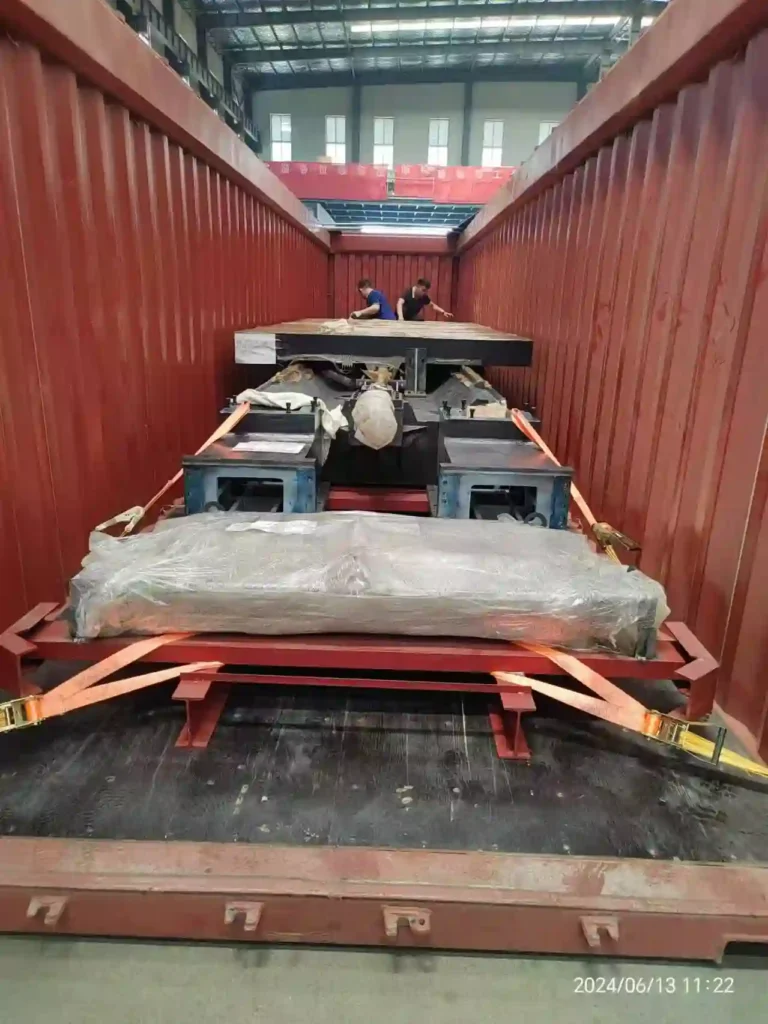
Ocean Freight: The Part Nobody Talks About CNC Gantry Machine Delivery Time
Here’s where a lot of first-time importers get surprised. The factory might finish in 45 days, but then you’ve got another 15 to 45 days just for the boat ride, depending on your destination.
Europe? Roughly 30–35 days. Southeast Asia? Maybe 15–20. South America or Africa? You’re looking at closer to 40–45 days, sometimes more if customs decides to get friendly.
And that’s assuming clear weather, no port strikes, and no container backlogs.
Pro tip: Ask your supplier for a CIF (Cost, Insurance, Freight) quote that includes sea freight. Then add a 10–15% buffer to your timeline.
Installation – Where the Real Work Begins (CNC Gantry Machine Delivery Time Stage 2)
Okay, the machine has arrived. Now the fun really starts. Installation isn’t just “put it there and plug it in.” With gantry machines, it’s a multi-day process that requires serious attention to detail.
Site Preparation (Before the Machine Even Shows Up)
If you haven’t prepped your foundation yet, stop everything. Gantry machining centers are heavy—we’re talking 18,000 kg or more. You need concrete with a compressive strength of at least 1800 N/cm² and bearing strength over 5 tons per square meter.
Check these boxes before arrival:
- Cracks in concrete? Fix them. No exceptions.
- Space requirements – At least 500mm clearance above the machine for crane access.
- Vibration isolation – Add shockproof materials around the foundation.
- Curing time – Fresh concrete needs 28 days to reach full strength. Don’t rush this.
Unpacking and Positioning
When the crate arrives, your first job is the unpacking inspection. Check against the packing list immediately. Look for:
- Any shipping damage to the sheet metal
- All cables and accessories accounted for
- Anti-rust coating intact on guideways
Then comes the rigging and positioning. This is crane work—don’t DIY this unless you’ve done it before. The machine needs to be moved into position without structural stress on the bed or columns.
Leveling: Not Optional
Here’s where good installers separate from amateurs. Gantry machines don’t just sit on the floor and work. You need multi-point precision leveling using adjustment horns (leveling pads).
Why does leveling matter so much? Because if the bed isn’t perfectly level, the entire gantry structure twists. That means:
- Bad geometric accuracy
- Uneven tool wear
- Permanent frame deformation over time
Expect to spend 2–4 hours just on leveling and initial alignment. And then check it again after a few weeks of runtime—machines settle.
Overseas Commissioning – Making It Actually Run
This is where the real value—or real headache—shows up. Commissioning is the process of turning a stationary machine into a productive one. With overseas deliveries, you’ve got two options: on-site technician or remote guidance.
On-Site Installation and Training
Many reputable Chinese manufacturers now offer field service teams that travel to your facility. The WMTCNC team, for example, recently completed a full installation and commissioning in Indonesia—unpacking, leveling, precision testing, trial cutting, and operator training.
What does a full-on-site commissioning include?
| Phase | Activities | Typical Duration |
|---|---|---|
| Assessment | Site verification, power/air supply check, safety clearances | 0.5–1 day |
| Mechanical | Guards assembly, way covers, coolant system, chip conveyor | 1–2 days |
| Electrical | Main power connection, servo drives, CNC control wiring | 1 day |
| Commissioning | Axis calibration, spindle run-in, parameter tuning | 1–2 days |
| Testing | Circular test per ISO 10791-8, trial cutting, accuracy validation | 1 day |
| Training | Operator training, maintenance walkthrough, Q&A | 1–2 days |
| Total | Full process | 5–10 days |
Why ISO 10791 Matters
When your technician does precision testing, they should reference ISO 10791 standards—specifically Part 8 for contouring performance via circular tests in XY, YZ, and XZ planes. This isn’t just paperwork. It’s how you verify your machine is actually accurate.
Remote Commissioning (The New Normal)
Post-pandemic, remote commissioning has become surprisingly effective. With good internet and a video link, an experienced engineer can guide your local team through:
- Parameter verification
- Basic axis jogging and direction checks
- Spindle warm-up and run-in
- Simple test cuts
But for full precision calibration? You really want boots on the ground. There’s no substitute for a technician with a marble square and a dial indicator.
Common Headaches (And How to Avoid Them)
Let me save you some pain. Here’s what actually goes wrong on overseas deliveries:
Problem 1: Incompatible site conditions upon arrival
The fix: Do a remote site survey before shipping. Send photos of your foundation, electrical panel, and access routes. Have the supplier verify everything.
Problem 2: Missing specialized tools for commissioning
The fix: Ask for a tool list in advance. If you don’t have what’s needed, have the technician bring critical tools or arrange local rental.
Problem 3: Language barriers during training
The fix: Get multilingual manuals upfront. Many good suppliers provide English and local language documentation.
Problem 4: Warranty clock starts ticking at delivery
The fix: Most warranties start from the shipment date, not installation. If your machine sits in a crate for three months, you’re losing warranty coverage.
How to Choose a Supplier That Delivers (Literally)
Here’s my checklist after dealing with dozens of overseas suppliers:
✅ Ask for recent customer references – Call a shop that bought the same model 6 months ago.
✅ Verify pre-delivery inspection – Do they test every axis before crating? Ask for video evidence.
✅ Check lead time commitments – On-time delivery near 100% = disciplined production planning.
✅ Confirm after-sales support – Remote diagnostics, field technicians, spare parts availability.
✅ Get the warranty in writing – Typically 12 months. Understand what’s excluded.
Realistic Timeline Summary
Here’s what you can actually expect from order to first cut:
| Stage | Time | Notes |
|---|---|---|
| Order confirmation & deposit | Day 1 | – |
| Engineering & manufacturing | 30–90 days | Standard machines ~45 days; custom builds 60–120 days |
| Pre-delivery inspection | 2–3 days | Before crating |
| Ocean freight | 15–45 days | Depends on destination port |
| Customs clearance | 3–7 days | Varies by country |
| On-site installation | 2–4 days | Foundation must be ready |
| Commissioning & testing | 2–5 days | Includes precision calibration |
| Operator training | 1–2 days | On-site or remote |
| Total (typical) | 60–150 days | Standard builds on the shorter side |
Final Thoughts
I’ve been doing this long enough to tell you: CNC Gantry Machine Delivery Time is less about the calendar and more about preparation. The shops that have their foundation ready, their electrical sorted, and their access cleared before the crate arrives? They’re cutting parts in half the time of the guys who figure it out as they go.
Want to dig deeper into specific components? Take a look at our guide on gantry machine spindle selection and maintenance – getting that right makes a huge difference in long-term reliability.
For more authoritative info on international standards, check out ISO 230 series on machine tool test codes – it’s the reference we all use for precision verification.
Happy machining, and may your delivery show up on schedule!