Choosing between a Moving Table vs Moving Column Gantry Machine is the most common and confusing decision for factory owners, machining supervisors, and procurement engineers. Many buyers only compare surface prices and basic parameters, ignoring structural adaptability, long-term precision retention, and actual production compatibility. This leads to low machining efficiency, frequent precision deviations, and unnecessary maintenance costs after equipment installation. Based on years of on-site machining experience and customer service cases, this article delivers practical, shop-floor-level comparisons and actionable selection tips to help you avoid wrong investment decisions and pick the most cost-effective gantry machine for your production scenarios.
1. Core Structural Difference between Moving Table vs Moving Column Gantry Machine(Working Principle)
The fundamental gap between the Moving Table vs Moving Column Gantry Machine lies in the moving parts and force-bearing structure. This core structural difference determines all subsequent performance differences, including rigidity, precision, stability, floor space occupation, and service life, which is the primary basis for equipment selection.
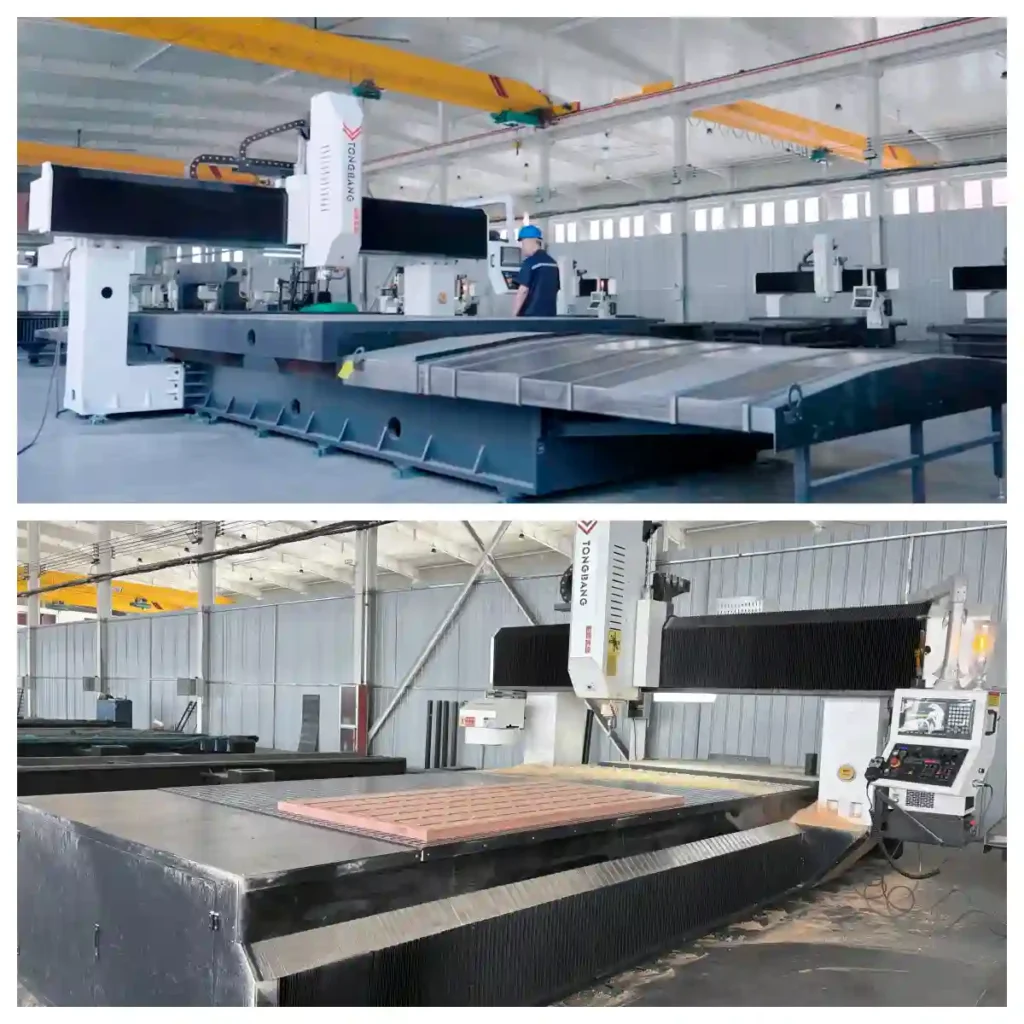
Moving Table Gantry Machine: The overall gantry frame, including double columns and cross beam, is completely fixed on the machine bed. Only the worktable carries the workpiece and moves linearly along the X-axis. The spindle head independently travels on the Y and Z axes to complete milling, drilling, and boring processes. The whole machine features a simple transmission structure, small motion inertia, and sensitive dynamic response, which is friendly for high-speed finishing of small and medium workpieces.
Moving Column Gantry Machine: The worktable is fully fixed and integrated with the machine bed without any displacement during processing. The double columns and gantry beam form an integral rigid frame, moving synchronously along the X-axis guide rail. It cancels the traditional long-stroke moving worktable structure, optimizes the overall force-bearing system, and avoids precision loss caused by worktable shaking and guide rail deformation. This structural design is the core advantage for heavy-duty and long-stroke machining.
2. Rigidity & Machining Stability between Moving Table vs Moving Column Gantry Machine
For heavy-duty and high-precision machining, structural rigidity and running stability are the top evaluation indicators.Moving Table vs Moving Column Gantry Machine shows extremely obvious differences in anti-deformation, anti-vibration, and long-term precision retention performance in actual production.
The moving table gantry machine relies on the reciprocating movement of the worktable to realize X-axis feeding. When bearing heavy workpieces, the long-span guide rail will bear uneven instantaneous cutting force and gravity load. High-speed operation and intermittent cutting will cause slight vibration and micro-deformation, which will gradually affect machining accuracy. It performs stably in medium and light load finishing and conventional batch processing, but is prone to tool flutter and dimensional deviation in heavy cutting scenarios.
The moving column gantry machine adopts an integral cast iron bed and thickened fixed worktable. Since the workpiece and worktable remain static during the whole processing process, no dynamic load impact is generated on the guide rail and bed. The symmetrical double-column closed frame structure effectively resists torsion, cutting impact, and mechanical vibration. Even under long-term continuous heavy cutting and rough machining, it can maintain stable dimensional accuracy and surface roughness, with far better long-term precision retention than the moving table model.
3. Stroke Range & Floor Space Utilization between Moving Table vs Moving Column Gantry Machine
Factory space limitation and processing stroke requirements are key pain points for medium and large machining factories. The structural difference makes Moving Table vs Moving Column Gantry Machine differ greatly in space utilization and stroke expansion capability, which directly affects factory layout and production expansion plans.
The moving table gantry machine needs to reserve sufficient sliding stroke space on both sides of the worktable to avoid collision during operation. Under the same effective X-axis processing stroke, the overall equipment length is longer, occupying more factory linear space. Its space utilization rate is low, and it is not suitable for factories with narrow site and limited length space. In addition, the ultra-long stroke moving table is prone to deflection, limiting the maximum customizable stroke.
The moving column gantry machine has a fixed worktable with no redundant reserved sliding space. Under the same processing stroke, its floor area is only 60%-70% of the moving table model, greatly saving factory space. It supports ultra-long stroke customized design and is perfectly suitable for strip structural parts, large plate workpieces, and ultra-long mechanical parts. The fixed bed structure ensures the flatness of the processing area, and the stroke expansion will not damage the overall structural stability.
4. Load Capacity & Applicable Workpieces between Moving Table vs Moving Column Gantry Machine
Load capacity directly defines the machining boundary and application scenarios of the two types of gantry machines, which is the core reference for buyers to match processing business.
The moving table gantry machine has a limited bearing capacity. Excessively heavy workpieces will increase the moving inertia of the worktable, reduce positioning and repeated positioning accuracy, and accelerate the wear of guide rails, lead screws, and transmission components. It is mainly used for small and medium injection molds, die-casting molds, conventional mechanical parts, and ordinary plate finishing, with stable performance for standard light and medium load batch processing.
The moving column gantry machine completely breaks the load limit of the moving table structure. The thickened fixed worktable and integral bed can bear ultra-heavy workpieces such as large wind energy structural parts, aerospace thick plates, hydraulic equipment bases, and large mold bases. It supports one-time clamping and full-stroke integral processing without segmented positioning and secondary clamping, effectively improving processing consistency and production efficiency for large workpieces.
5. Maintenance Difficulty & Long-Term Service Life between Moving Table vs Moving Column Gantry Machine
For factory standardized operation, daily maintenance difficulty and long-term failure rate directly determine the comprehensive production cost. The two gantry machines have completely different maintenance logics and durability performance in long-term operation.
The moving table gantry machine has fewer moving parts and a simple transmission system. The guide rail and lead screw operate stably with low wear rate. Daily maintenance only requires conventional cleaning, chip removal, and lubrication. The failure rate of electrical and mechanical parts is extremely low. With standardized daily maintenance, the service life of conventional models can reach more than 10 years, and the later maintenance cost is very controllable.
The moving column gantry machine adopts integral gantry linkage movement, with large moving parts and high dynamic operation load. Long-term high-speed operation will cause a slight synchronous deviation of the double columns and the guide rail flatness error. It requires regular professional calibration of the synchronous drive system and guide rail precision, with a higher maintenance workload and technical threshold. However, its core fixed parts have low wear, so the overall service life is longer, and the long-term precision attenuation is slower than that of the moving table model.
6. Procurement Cost & Long-Term Cost-Performance Analysis between Moving Table vs Moving Column Gantry Machine
Initial procurement cost and long-term comprehensive cost performance are key factors for factory investment decision-making. The two devices have obvious price gaps and scenario-based cost advantages.
Under the same spindle power, stroke, and configuration parameters, the moving table gantry machine has lower manufacturing difficulty and material cost, with a more affordable quotation. It is the best cost-effective choice for small and medium-sized factories with a limited budget and mainly engaged in conventional standard parts processing and small and medium mold production.
The moving column gantry machine has higher structural design standards, thicker cast iron materials, and more stringent assembly precision requirements, leading to higher initial procurement prices. But in long-stroke, heavy-load, and high-precision continuous processing scenarios, its stable precision, low failure rate, and high processing efficiency can completely offset the early investment gap. For large-scale processing enterprises with high-precision and heavy-duty processing orders, its long-term comprehensive cost performance is far better than the moving table model.
Full Comparison Table between Moving Table vs Moving Column Gantry Machine
| Comparison Item | Moving Table Gantry | Moving Column Gantry |
| Moving Structure | Fixed gantry, movable worktable | Fixed worktable, movable gantry column |
| Rigidity | Medium, suitable for light cutting | High, suitable for heavy cutting |
| Floor Space | Large | Small (30%-40% space saved) |
| Load Capacity | Medium & light load | Ultra-heavy load |
| Maintenance | Easy, low cost | Slightly difficult, regular calibration needed |
| Applicable Scenarios | Small molds, conventional parts | Large workpieces, aerospace, new energy |
7. Practical Selection Tips for Buyers
Combined with years of on-site debugging, after-sales service, and customer feedback data, we summarize the most straightforward, error-free selection rules for factory procurement, completely based on actual production needs.
Choose Moving Table Gantry If: Your factory mainly processes medium and small workpieces, standard molds, and conventional mechanical parts; you have sufficient factory floor space, a limited one-time procurement budget, and focus on low daily maintenance costs and stable batch production. This model features high cost performance and low failure rate, which is the most reliable choice for small and medium-sized batch processing.
Choose Moving Column Gantry If: You need ultra-long stroke processing, undertake heavy-duty mold bases, large equipment structural parts, new energy, and aerospace precision parts orders; you have strict requirements for machining stability and precision consistency, or your factory has narrow space and needs high space utilization equipment. It can fully meet high-standard heavy-duty processing and large-scale workpiece production needs.
To ensure the purchased equipment meets international precision manufacturing standards, you can refer to ISO 10791 machining center precision standards to verify the geometric accuracy and positioning accuracy parameters of the gantry machine before procurement.
If you want to know more about gantry machine configuration matching, spindle selection, and parameter debugging skills to avoid configuration waste, you can check our previous in-depth guide.
Final Conclusion
There is no absolute good or bad between the Moving Table vs Moving Column Gantry Machine in the machinery industry, only scenario adaptation. The core of scientific procurement selection is to match the equipment structural performance with your actual processing workpiece specifications, load demands, factory site conditions, and long-term production expansion plans.
Blindly pursuing high-end configuration or low-price equipment will lead to production bottlenecks or cost waste. Choosing the right gantry machine can effectively improve machining efficiency, reduce equipment failure rate and later maintenance costs, and create stable and long-term profit growth for the factory.