
I. What is Tool Chatter in CNC Gantry Milling Machine?
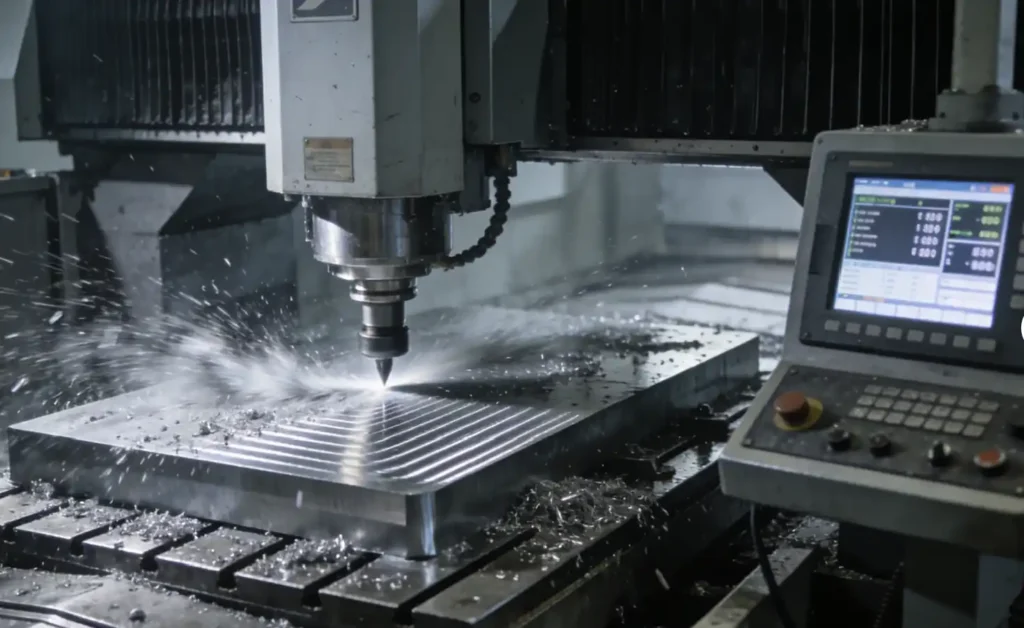
For us, CNC gantry milling Machine operators, Chatter in CNC gantry milling machine is a perennial problem! Simply put, it’s when the tool and workpiece shake violently during cutting.
Think about it: the tool shank looks rigid, but it actually has some elasticity.
During cutting, the workpiece applies a radial force to the tool. When the force presses down, the tool body deforms, reducing the cutting depth. When the force eases, the tool body springs back, increasing the depth again. This back-and-forth motion creates chatter in the CNC Gantry Milling Machine.
Chatter in CNC Gantry Milling Machine is easy to spot: the machined surface develops wavy patterns with burrs, and the tool emits a piercing “humming” noise. Worse still, the insert can shatter, and the workpiece dimensions can shift—especially when machining thick plates or hard materials, where chatter in either heavy-duty CNC Gantry Milling Machine or light-duty CNC Gantry Milling Machine is highly likely.
II. Chatter in CNC Gantry Milling Machine -Related Questions and Answers of CNC Gantry Milling Machine
Question 1: Does harder workpiece material make chatter more likely?
Answer: Absolutely! Hard, tough workpieces create greater cutting resistance, subjecting the tool to increased stress and deformation—making chatter far more likely. When machining Cr12MoV hard steel without optimized parameters, the vibration was so severe the workpiece nearly slipped from the clamps. It proved far trickier than machining ordinary mild steel. When encountering hard materials, switch to sturdier tools and reduce feed rates—that’s the surefire solution.
Question 2: Does the machine tool itself affect chatter?
Answer: Absolutely! The machine is our “foundation” for work—if the foundation is weak, it will shake. Large spindle clearance, worn-out guideways, or loose bed screws all compromise rigidity. I once had a case where the tool selection and parameters were perfect, yet chatter persisted. Turned out the spindle bearing was loose—tightening it instantly stabilized the process. Only a rigid machine can hold the tool steady, naturally reducing the chatter in CNC Gantry Milling Machine.
III. Benefits of Eliminating Tool Chatter
Parts meet specifications reliably, eliminating rework. What the drawing calls for is what you get.
The machined surface is smooth and polished, eliminating the need for subsequent grinding. This saves both time and labor costs.
Tools are less prone to chipping and wear, and machine tools experience fewer malfunctions. Over the long term, this translates to significant cost savings.
There’s no need for frequent machine downtime to adjust parameters or repair workpieces. Operations run smoothly, naturally boosting efficiency and stabilizing production rhythms.
IV. Steps to Address Tool Chatter
Select thick, short tools—the sturdier the shank, the better it resists vibration. Ensure tight installation by thoroughly cleaning swarf and oil residue from the tool holder and spindle, as loose fits cause chatter. Replace chipped or dull inserts immediately; never compromise.
Adjust cutting parameters flexibly. Keep feed rates moderate—slightly slower is better. Set cutting speed based on material: slower for hard materials, slightly faster for soft ones. Avoid excessive single-pass depths; layer cuts for stability. I typically split 5mm-deep cuts into 2-3 passes, significantly reducing noticeable vibration.
Inspect the machine before operation: Check if the spindle wobbles during rotation—adjust if excessive. Examine guideways for play—repair if found. Tighten any loose screws on the bed or crossbeam. Secure workpieces firmly; reinforce large or thin-walled parts with auxiliary supports to prevent movement during cutting.
Always test-cut before production! Use scrap material or workpiece offcuts to check for abnormal noises or vibrations. If issues arise, first adjust parameters; if that fails, change tools; finally, inspect the machine and fixtures. Troubleshoot step by step, and you’ll get it right.
V. Practical Results
When machining cast iron bed plates, severe chatter in CNC gantry milling machine caused rough surfaces and dimensional inaccuracies, leading to daily rework. Switching to a short, φ25 carbide tool with layered cutting and reducing the feed rate from 0.2 to 0.15 eliminated vibration entirely! Surfaces now feel smooth to the touch, dimensions are precise, and tool life has significantly improved—saving substantial tooling costs.
Machining hard steel molds proved even more challenging. The original setup caused severe vibration, leaving the mold surface covered in ripples and pushing the rework rate close to 50%. I switched to high-strength tools, slowed the feed rate, adopted layered cutting, and added two extra support blocks to clamp the workpiece more securely. This eliminated vibration, dropped the rework rate to zero, and even sped up production. The boss praised the work as “excellent.”